
October 31, 2025
Clinician-Guided Zoloft Prescription Online: Five Safety Checks to Trust the Service You Choose

📌 Key Takeaways
Feeling cautious about sharing health details with an online Zoloft service isn’t paranoia—it’s the first sign you’re taking your mental health seriously.
- Caution Is a Strength, Not a Weakness: Hesitation before trusting an online medication service signals smart self-advocacy, not unnecessary worry.
- Five Questions Cut Through the Noise: Checking for licensed clinicians, clear eligibility boundaries, transparent review processes, emergency protocols, and realistic promises quickly separates trustworthy services from risky shortcuts.
- Hours, Not Seconds, Signal Safety: Legitimate clinical decisions require human review and time—“instant approval” promises are red flags, not selling points.
- Bridge Services Aren’t Replacements: Clinician-guided online Zoloft services work best as temporary bridges between providers or during insurance gaps, not as substitutes for ongoing psychiatric care.
- Asking Direct Questions Is Empowering: Requesting specifics about follow-up frequency, symptom management, and dose adjustment protocols reveals whether a service welcomes accountability or avoids it.
Equipped beats anxious. Five checks, and you’re ready to choose.
Busy professionals managing depression or anxiety with Zoloft will find a practical framework here, preparing them for the detailed safety criteria explained below.
Feeling Cautious Is a Good Sign
Hesitation before sharing health details online isn’t paranoia. It’s common sense.
A clinician-guided Zoloft prescription online is a way for eligible adults to get help with their existing Zoloft prescription through a streamlined digital process that still centers licensed clinicians and medical oversight—not shortcuts or anonymous pill mills. Think of it like airport security: a good system gets you where you need to go efficiently, but it doesn’t skip the safety checks to save time.
Picture this scenario. You’re hovering over an online intake form, cursor blinking, wondering: “Is this actually legitimate? Will a real clinician review my information, or is some auto-approval system?” That uncertainty is completely valid. By the end of this guide, you’ll have five clear safety checks you can apply to any service—so you can move forward with confidence instead of staying stuck.
Why Safety Checks Matter
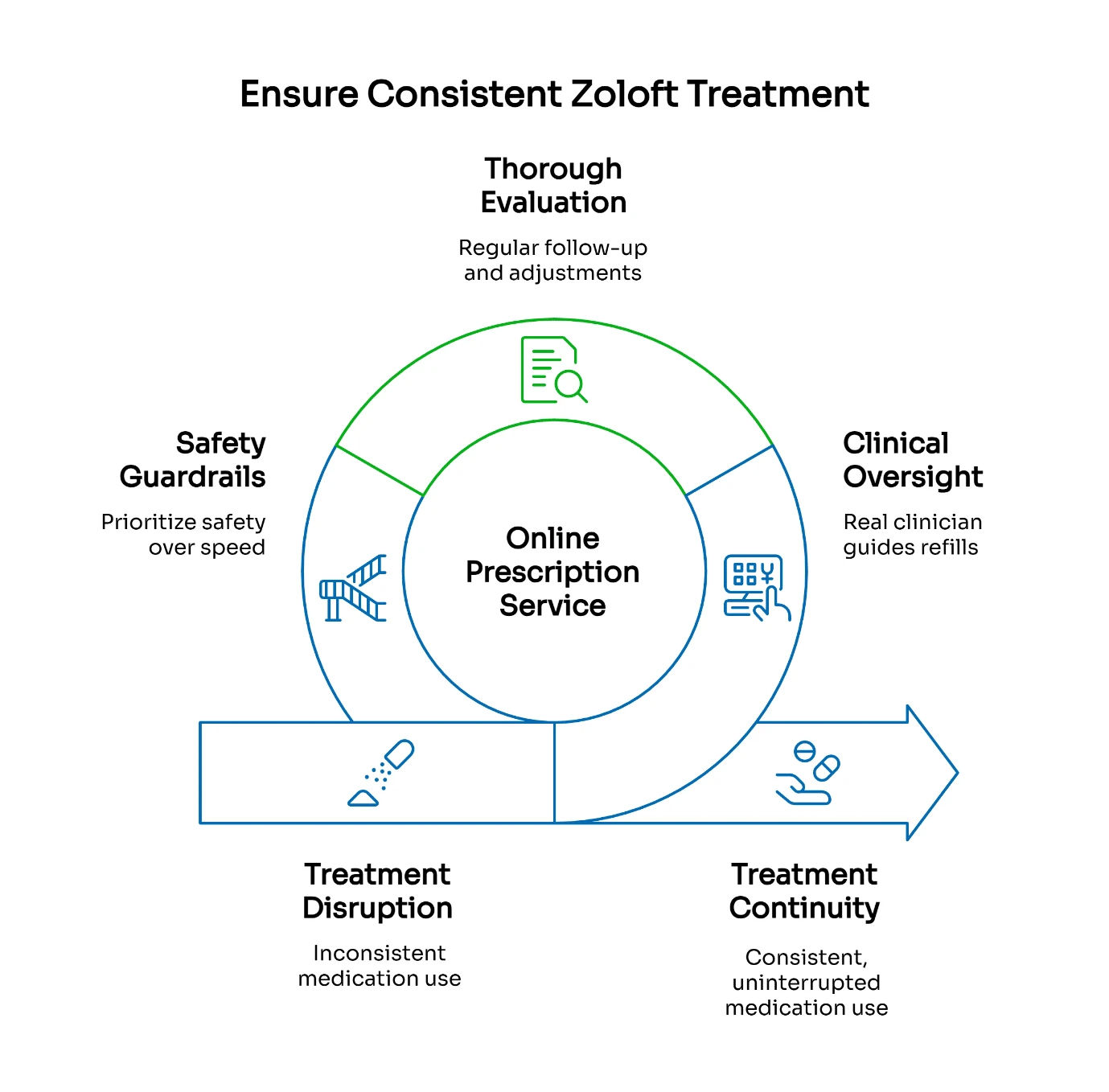
Zoloft (sertraline) works best with consistent, uninterrupted use and careful monitoring over time. Running out unexpectedly or scrambling for last-minute refills can disrupt treatment continuity. Getting a Zoloft prescription online through a clinician-guided service can help prevent last-minute refill panic and unintended gaps in treatment. It does this by pairing streamlined online steps with real clinical oversight, so refills are planned before they become emergencies.
But not every online option operates the same way. The American Psychiatric Association’s clinical guidelines emphasize that treating depression and anxiety requires thorough evaluation, regular follow-up, and treatment adjustments over months—not days. That’s why knowing what separates a trustworthy service from a questionable one matters. Services that emphasize safety guardrails over “speed at any cost” are more aligned with responsible care than those advertising instant approvals with no questions asked.
Five Safety Checks for Any Clinician-Guided Zoloft Service
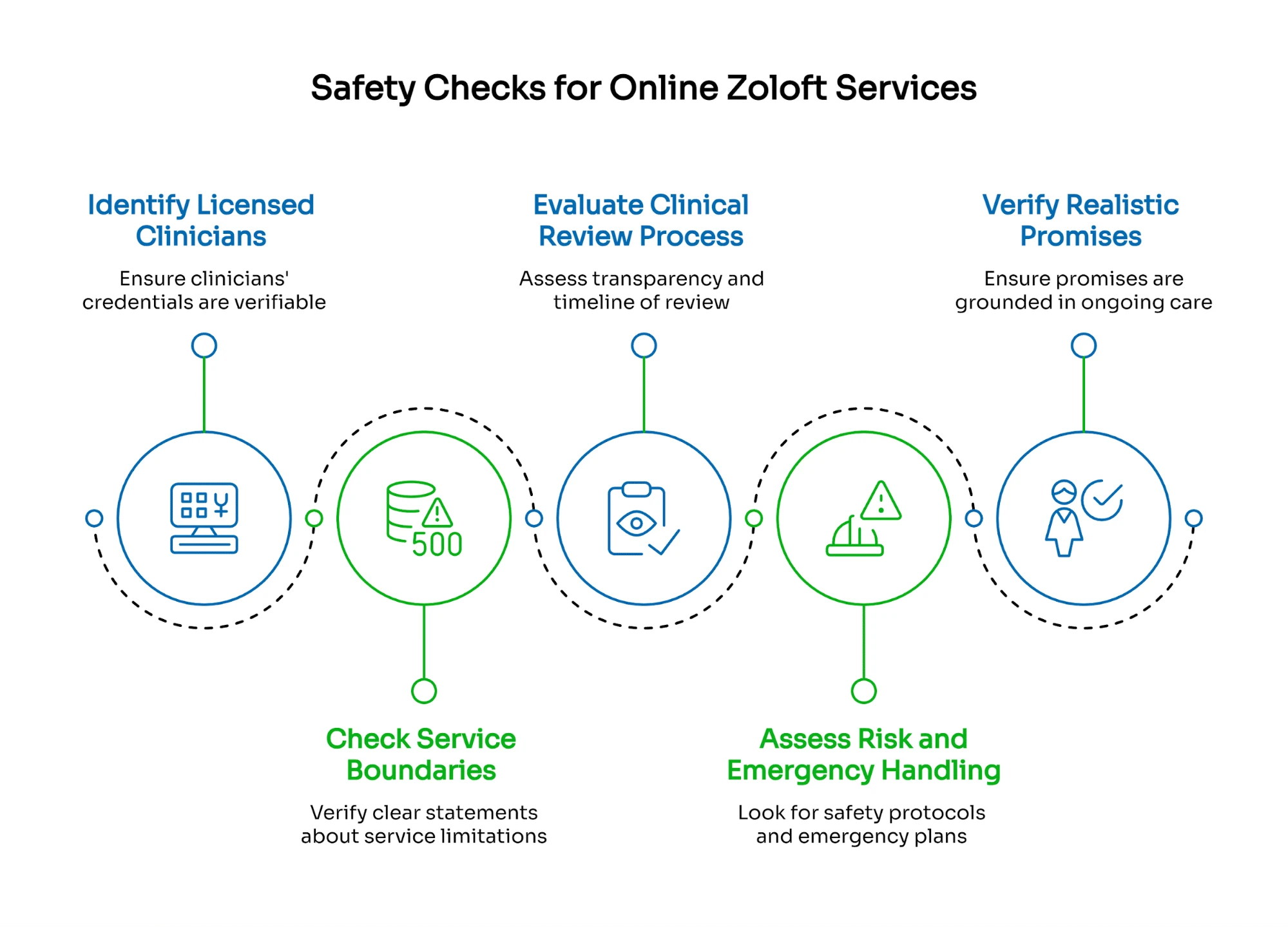
Safety Check #1: Are Licensed Clinicians Clearly Front and Center?
What to look for: The service openly displays who reviews your request—physicians (MD/DO), nurse practitioners, or physician assistants with verifiable credentials. You should be able to find information about the physician-led team behind the service.
Red flags: Vague language like “medical professionals” with no names, credentials, or state licensing information. If you can’t figure out who’s actually making prescribing decisions, that’s a problem.
Legitimate services for clinician-guided Zoloft prescriptions online clearly highlight licensed clinicians and eligibility criteria upfront.
Safety Check #2: Do They Spell Out Who They Can—and Can’t—Help?
What to look for: Clear statements about serving adults only, focusing on refills of existing medications, and listing what they won’t prescribe. A responsible service will openly state its boundaries.
Red flags: Promises to help “anyone” with “any medication” and no mention of limitations. Responsible services don’t handle everything—they focus on what they can do safely.
For example, Refill Genie specifically helps adults refill existing prescriptions and does not start new medications, diagnose acute conditions, or refill certain medication categories that require closer monitoring.
Safety Check #3: Is the Clinical Review Process Transparent?
What to look for: A clear explanation of the process—typically an intake form, followed by clinician review, clarifying questions (often via text or secure message), and then an e-prescription if appropriate. The timeline should be measured in hours, not seconds.
Research published in JAMA Psychiatry confirms that ongoing follow-up for several months is essential to monitor response, side effects, and safety. Look for services that schedule initial follow-ups within a few weeks and offer regular check-ins every four to eight weeks during any dose changes.
Red flags: “Instant approval” or “prescription in minutes” with no human review mentioned. Legitimate clinical decisions take time because a real person is evaluating your information.
Transparent explanations of how information is reviewed and how prescribing decisions are made are key trust builders.
Safety Check #4: How Do They Handle Risk and Emergencies?
What to look for: Direct questions about mood changes, any history of concerning symptoms, and a clear emergency plan. The service should explain when they cannot safely prescribe and have a process to coordinate higher-level care when needed.
According to the Federation of State Medical Boards’ telehealth guidance, online clinicians must follow the same standards of care as in-person clinicians, including appropriate evaluation, risk assessment, and emergency planning.
Red flags: No safety or crisis information anywhere on the site. No screening questions about mood stability. Vague language like “we handle everything online” regardless of symptom severity.
If a service doesn’t talk openly about risk and emergencies, it’s not taking mental health care seriously.
Safety Check #5: Are Their Promises Realistic and Grounded in Ongoing Care?
What to look for: Language about “bridging gaps” between doctors or insurance changes, emphasis on re-establishing care with a primary provider, and realistic expectations. Good services explain that medication is one tool in a broader plan—many people benefit most when combining medication with therapy, lifestyle changes, and support.
They should also discuss common side effects upfront (such as nausea, headache, digestive changes, or sexual side effects) and explain “activation”—the temporary feeling of being more wired or anxious that some people experience early on.
Red flags: Claims like “never see a doctor again” or promises of unlimited refills with no check-ins. A Zoloft prescription refill service is a key component of a safe, clinician-guided Zoloft prescription online journey—but it’s designed to bridge temporary gaps, not replace ongoing psychiatric or primary care.
Services like Refill Genie position themselves as a resource for times of transition, encouraging patients to renew prescriptions online while working on establishing long-term care.
Myths vs. Reality About Online Zoloft Prescribing
Myth: “If it’s online, it must be cutting corners.” Reality: Many reputable services are founded by physicians who saw patients struggling with medication access. Online tools can support safer prescribing when built around clinical oversight, not replace it.
Myth: “Fast always means unsafe.” Reality: Efficiency often comes from streamlined forms, extended hours, and dedicated workflows—not skipped safety steps. A service that responds within hours isn’t necessarily rushing; it may simply be well-organized.
Myth: “Convenience means side effects don’t need close monitoring.” Reality: All SSRIs, including Zoloft, require careful monitoring—especially early on or around dose changes. That’s true whether your clinician is on a screen or in the room.
Putting It All Together
These five checks work for any online prescription refill service you’re evaluating. Before committing to any service, ask these questions directly:
- “How often will I meet with my clinician after starting or continuing Zoloft?”
- “What happens if I have new or worsening symptoms?”
- “How will we decide when to adjust my dose or try something different?”
A trustworthy service will welcome these questions and answer them clearly. Print these checks out, save them to your phone, or simply keep them in mind next time you’re wondering whether a service deserves your trust.
If you’d like to walk through how these safety checks apply to your situation, you can call our team to talk it over. You can also read what other patients say about Refill Genie to see how others have navigated the process.
Disclaimer: This content is for informational purposes only and does not constitute medical advice, diagnosis, or treatment. Always discuss medication decisions with your own healthcare provider.
Our Editorial Process
Our team reviews every guide for clarity, accuracy, and alignment with current clinical guidance before publication. We regularly update content when recommendations or best practices evolve.
About the Refill Genie Insights Team.
The Refill Genie Insights Team is our dedicated engine for synthesizing complex topics into clear, helpful guides. While our content is thoroughly reviewed for clarity and accuracy, it is for informational purposes and should not replace professional advice.