
March 1, 2026
Is Online Refilling Safe? Understanding the LegitScript Difference
📌 Key Takeaways
A legitimate online refill service makes safety easy to verify through independent certification, real doctor review, and clear limits on what it won’t prescribe.
- Look for Third-Party Proof: A LegitScript seal with a clickable verification link means an outside reviewer checked the business meets legal standards.
- Doctors Must Review Your Info: Any service offering prescriptions without a licensed clinician looking at your history is skipping a basic safety step.
- “No” Is a Good Sign: Refusing controlled substances, new medications, and drugs needing blood tests shows the service takes clinical boundaries seriously.
- Privacy Language Should Be Obvious: Before you enter personal details, you should see clear statements about encryption and HIPAA compliance.
- Verify the Business Itself: A real address, contact page, and visible policies mean you can hold someone accountable if something goes wrong.
Safe services make verification easy; risky ones make it hard.
People seeking emergency prescription refills while traveling or between doctors will quickly spot trustworthy providers using these checks, preparing them for the detailed process overview that follows.
~ ~ ~ ~ ~ ~ ~ ~ ~ ~ ~ ~ ~ ~ ~ ~ ~ ~ ~ ~ ~ ~ ~ ~ ~ ~ ~ ~ ~ ~ ~ ~ ~ ~ ~ ~ ~ ~ ~ ~ ~ ~ ~ ~ ~ ~ ~ ~ ~ ~ ~ ~ ~ ~
A legitimate online refill service should make safety easier to verify, not harder. Here’s what to check before you trust one.
Online refilling can be safe when the service shows real trust signals. A safe provider does not ask you to trust convenience alone. It shows third-party verification, real clinician review, clear privacy language, visible business transparency, and firm safety boundaries.
That hesitation you feel when staring at an unfamiliar website with your prescription running low? It’s healthy. When you’re away from your regular doctor and need a bridge refill for an existing medication, skepticism keeps you safe. The challenge is knowing what to look for. By understanding the core trust signals, the true value of LegitScript certification, and how to verify a provider’s safety protocols, you can evaluate a service quickly and make a fast, confident decision.
How to Tell If an Online Refill Service Is Safe in Under 60 Seconds
Before you fill out any intake form or share personal details, run through these five checks. A legitimate service should pass all of them.
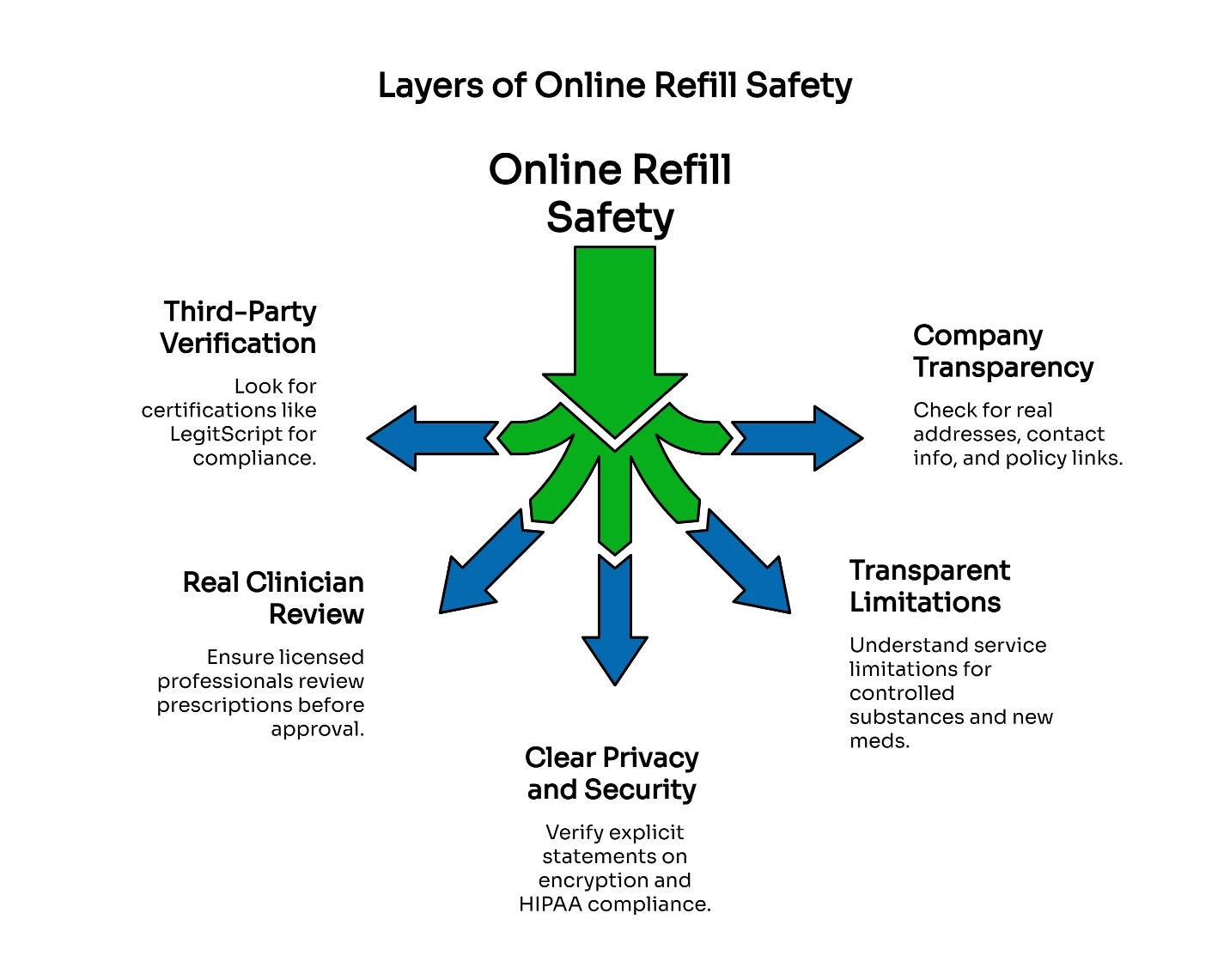
Third-party verification. Look for a recognizable certification seal from an organization like LegitScript. This isn’t just a badge—it means an independent reviewer has vetted the business for compliance with pharmacy and healthcare standards.
Real clinician review. The service should clearly state that a licensed doctor or healthcare provider reviews your information before any prescription decision happens. If a site promises prescriptions without any medical professional involved, walk away.
Clear privacy and security language. You should see explicit statements about encryption, HIPAA compliance, and how your health information is protected. Vague language or missing privacy policies are warning signs.
Transparent limitations. A trustworthy service will tell you upfront what it cannot do. Exclusions for controlled substances, new medications, and conditions requiring monitoring are signs of responsibility, not weakness.
Company transparency. Can you find a real business address, a contact page, and visible policy links? Legitimate providers make it easy to reach them and verify their identity.
Green Flags vs. Red Flags: The Safety Checklist
Use this table before trusting any online refill provider.
| Signal | Why It Matters | Green Flag | Red Flag |
|---|---|---|---|
| Third-party certification | Independent verification of compliance | LegitScript seal with clickable verification link | No certification or unrecognizable badges |
| Clinician involvement | Ensures medical appropriateness | Doctor reviews intake and contacts you before prescribing | ”No prescription needed” or instant approval promises |
| Privacy protections | Protects your health data | Clear HIPAA-compliant language, encrypted forms | Missing privacy policy or vague security claims |
| Medication boundaries | Shows clinical responsibility | Excludes controlled substances, new meds, monitoring-heavy drugs | Offers controlled substances casually or without safeguards |
| Response time claims | Realistic expectations | Specific windows like “within 12 hours” or “2-3 hours typically" | "Instant approval” with no review process |
| Business identity | Accountability and legitimacy | Visible address, contact page, policy links | Hidden ownership, offshore registration, no contact info |
| Realistic workflow | Legitimate care takes time | Text-based follow-up paired with doctor review | ”No prescription needed” or no intake process at all |
If a service fails even one of these checks, find another option.
The FDA’s BeSafeRx campaign offers similar verification guidance for online pharmacies, reminding consumers that legitimate healthcare operations—whether they are prescribing services or dispensing pharmacies—make safety verification transparent. The basic rule is simple: safe care makes verification easier; unsafe care makes it harder.
What LegitScript Is and Why It Matters
LegitScript is an independent certification company that verifies whether online healthcare and pharmacy businesses meet legal and safety standards. Major payment processors and advertising platforms require LegitScript certification before allowing healthcare merchants to operate, which gives the certification real enforcement power.
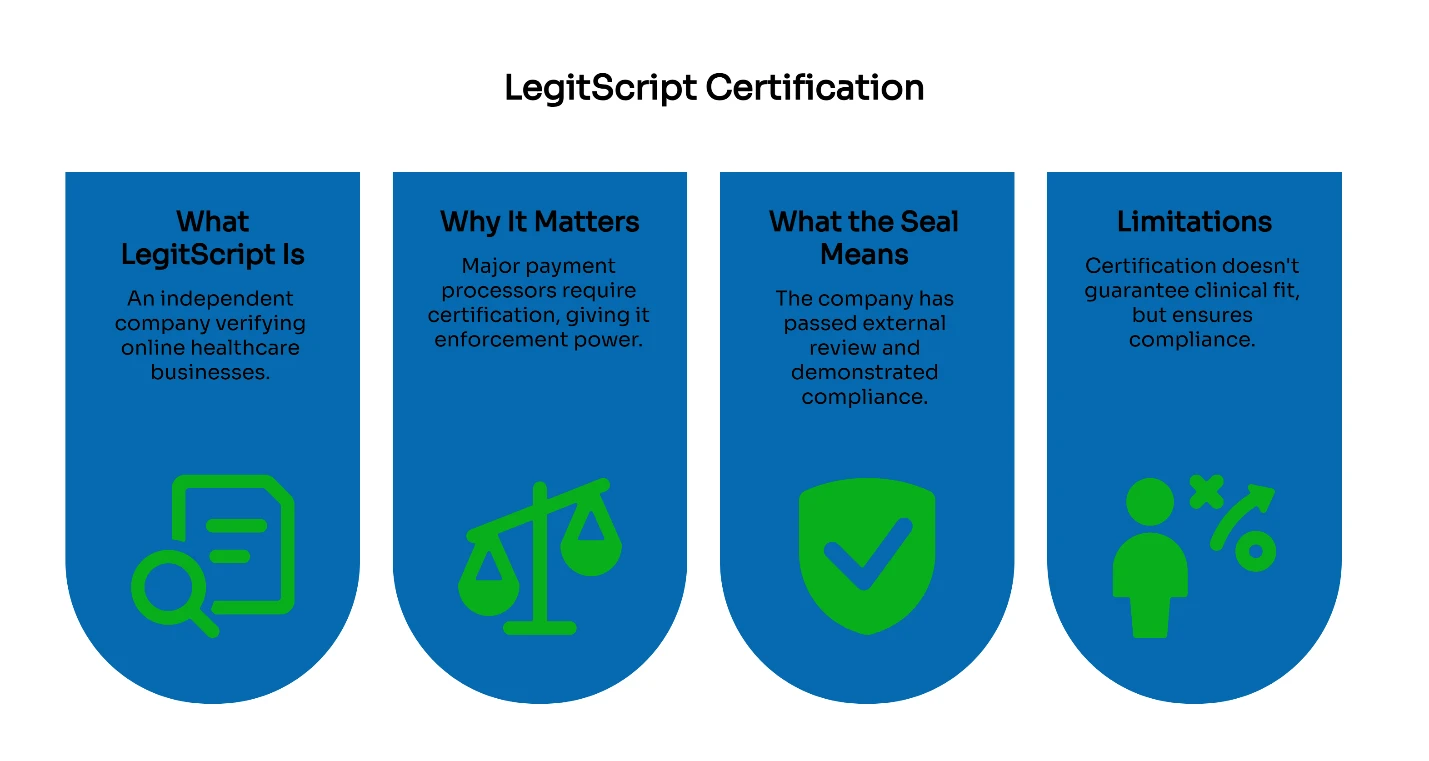
When a service displays a LegitScript seal, it means the company has submitted to external review and demonstrated compliance with applicable laws and industry standards. You can verify any site’s certification status directly through LegitScript’s website checker.
LegitScript certification doesn’t guarantee that a particular service is the right clinical fit for your specific situation. What it does guarantee is that the business has passed a serious third-party compliance review. For skeptical readers trying to separate legitimate providers from scams, that’s a powerful starting point—but clinician review, privacy standards, and clear exclusions still matter just as much.
How Refill Genie Shows Its Safety Signals
Refill Genie’s website demonstrates each of the trust markers covered above. The footer displays a LegitScript verification seal linked to a status-check page. The site explicitly states that forms and text messages are encrypted and HIPAA-compliant.
The process requires a licensed doctor to review your medical information and contact you directly via text before deciding whether a refill is appropriate. If it is, the prescription goes electronically to your pharmacy. If additional information is needed—or if certain refills require bloodwork—the service provides a lab order and interpretation rather than approving blindly.
The site is clear about what it won’t do. Refill Genie does not diagnose acute conditions or start new medications. Controlled substances, sedatives, muscle relaxants, and medications requiring close monitoring are excluded. The About Us page explains that the service was founded by physicians specifically to bridge care gaps, not to replace ongoing relationships with primary care providers.
“Found Refill Genie, double checked they were legit and away we went,” one reviewer wrote. “Super easy system with quick responses and follow ups.” That instinct to verify before trusting is exactly right—and legitimate services make verification straightforward.
When Online Refills Are Not the Right Choice
Safe services say “no” when appropriate. That’s a feature, not a flaw. Online refills are not the right fit when:
You have new symptoms or a medical emergency. These require in-person evaluation or emergency care, not a bridge refill.
You need a new medication. Legitimate refill services handle existing prescriptions you’ve already been taking. New diagnoses and new treatment plans belong with your primary provider.
You’re seeking controlled substances. Narcotics, sedatives, and similar medications have strict prescribing requirements that responsible online services won’t shortcut.
Your medication requires close monitoring. Some drugs need regular blood tests or other tracking. A legitimate service may require documentation or lab work before approving these refills—or may direct you to in-person care instead.
You need to re-establish long-term care. Bridge refills are exactly that—a bridge. They help you maintain continuity while you’re traveling, between doctors, or waiting for an appointment. They don’t replace the ongoing relationship with a local provider who knows your full history.
FAQ: Quick Answers for Skeptical Readers
Is LegitScript certification enough by itself?
LegitScript is a strong starting point, but combine it with the other checks. Look for clinician review, clear privacy language, transparent limitations, and real company information. No single signal proves safety alone.
Does a safe service still require a real doctor review?
Yes. Any service that offers prescriptions without a licensed clinician reviewing your information is bypassing a fundamental safety step. The review might happen via text or secure messaging rather than a video call, but it should happen.
Can a safe service still say no?
Yes. In fact, that’s often a good sign. Refusing unsafe categories, new medication starts, or cases that need bloodwork is part of safe practice. A service that claims to refill anything should raise concerns, not confidence.
Why would a legitimate service refuse some medications?
Because responsible providers prioritize safety over revenue. Refusing controlled substances, monitoring-heavy medications, and new prescriptions isn’t a limitation—it’s proof that the service takes clinical boundaries seriously.
What privacy language should I expect before I submit anything?
Look for explicit statements about HIPAA compliance, encryption, and how your health information will be used and protected. If privacy protections aren’t clearly stated before you enter personal details, reconsider.
Safety Is About Standards, Not Hype
The difference between a trustworthy online refill service and a risky one comes down to visible, verifiable standards. A trustworthy platform proves its reliability through independent compliance audits, direct oversight from licensed medical professionals, bank-level data encryption, strict prescribing boundaries, and a fully verifiable corporate footprint.
When you find a service that passes these checks, you’ve found one that takes your safety seriously. When a service fails them, keep looking.
If you’re ready to see how a legitimate bridge refill works, start by reading the FAQs or learning more about the team. When you’re confident in what you’ve verified, you can start your refill request.
Disclaimer: This article is for informational purposes only and does not replace medical advice, diagnosis, or emergency care. Online refill services are not appropriate for new symptoms, medical emergencies, new medication requests, or controlled substances. Refill Genie is intended as a temporary bridge for existing maintenance medications; readers should re-establish ongoing care with a local licensed provider as soon as possible.
Our Editorial Process:
Our expert team uses AI tools to help organize and structure our initial drafts. Every piece is then extensively rewritten, fact-checked, and enriched with first-hand insights and experiences by expert humans on our Insights Team to ensure accuracy and clarity.
By: The Refill Genie Insights Team
The Refill Genie Insights Team is our dedicated engine for synthesizing complex topics into clear, helpful guides. While our content is thoroughly reviewed for clarity and accuracy, it is for informational purposes and should not replace professional advice.