
May 20, 2026
Doctor Closed, Bottle Empty: What to Check Before You Wait
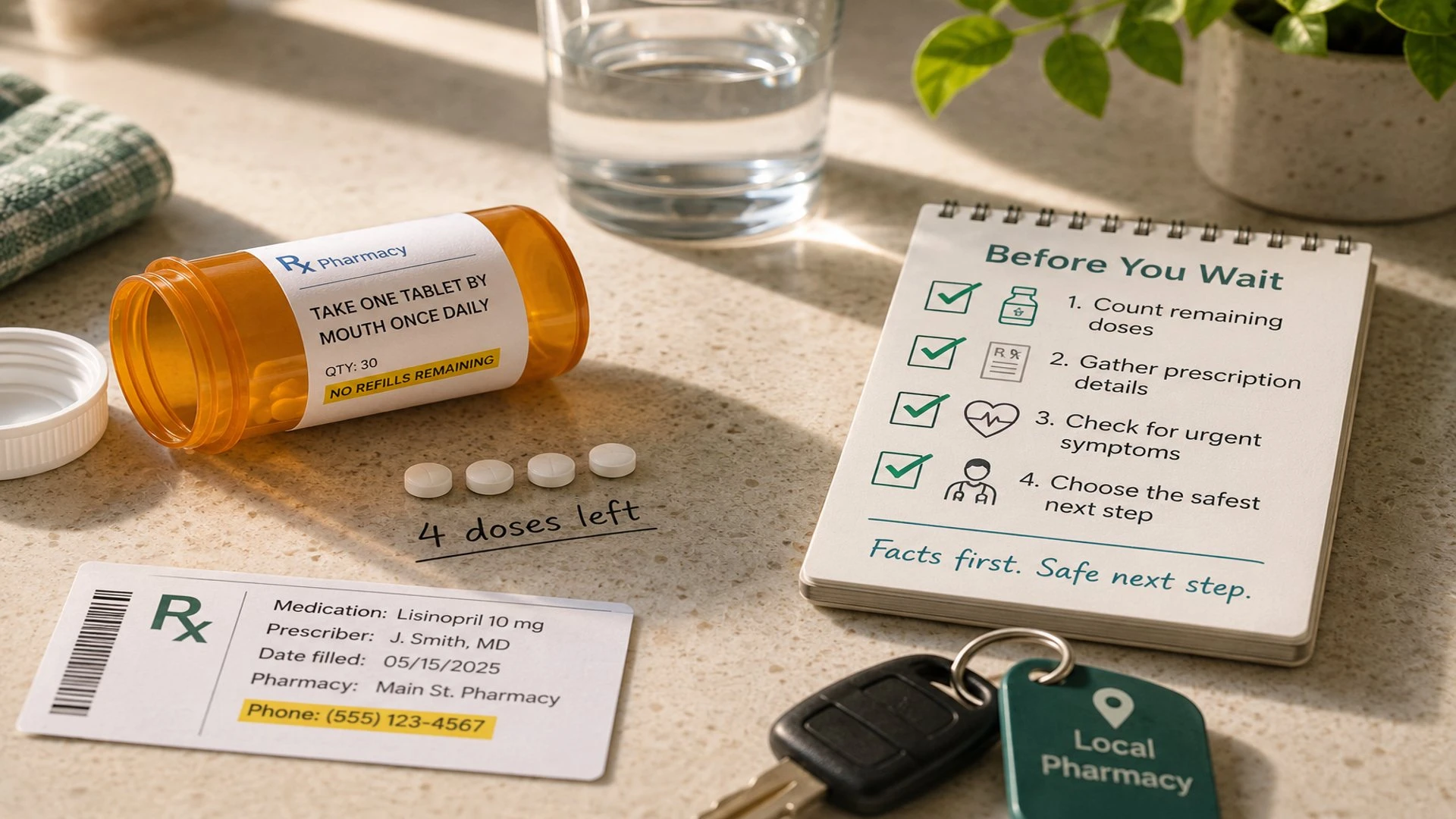
📌 Key Takeaways
An empty medication bottle calls for calm facts first, not guessing or risky shortcuts.
- Count Doses First: Counting what remains turns panic into a clear decision about how quickly help is needed.
- Check Safety Early: Severe symptoms, unsafe feelings, or unclear risks may call for urgent or emergency care.
- Gather Label Details: Exact medication details help clinicians review refill gaps more safely and avoid avoidable mistakes.
- Know Bridge Limits: Bridge refills may help existing medications, but they cannot replace regular medical care.
- Plan Earlier Next Time: Refill reminders, label photos, and prescriber details can reduce future last-minute stress.
Clear facts make refill gaps safer, faster, and less overwhelming.
Adults managing ongoing prescriptions will gain a calmer refill decision path here, preparing them for the detailed overview that follows.
~ ~ ~ ~ ~ ~ ~ ~ ~ ~ ~ ~ ~ ~ ~ ~ ~ ~
The bottle sounds wrong.
You pick up your medication bottle and realize it may not contain enough doses, and realize there may not be enough medication left to get through the night, the weekend, or the next available appointment. The doctor’s office is closed. The refill line is quiet. The label suddenly feels more important than it did 17 minutes ago.
You are not careless for landing here. Refill gaps happen during busy weeks, delayed appointments, travel, coverage changes, and ordinary life. Prioritize the immediate clinical risk over the frustration of the situation.
If your doctor is closed and your medication bottle is empty or nearly empty, first count what is left, gather your medication details, and check for urgent symptoms or safety concerns. If waiting feels unsafe, seek urgent or emergency care. If the medication is an existing prescription and a temporary refill may be clinically appropriate, a clinician-reviewed bridge path may help.
Think of this moment like reaching a closed bridge. Your normal route is blocked, but that does not mean the only choices are waiting helplessly or taking a risky shortcut. You need a safe detour.
Start Here: Count What Is Left Before You Decide to Wait
Start with the simplest fact: how many doses are actually left?
Put the bottle on the counter. Count the remaining pills, tablets, capsules, patches, or other doses. Then compare that number with your usual schedule. This step sounds basic, but it changes the problem from a blur into a decision.
You are trying to answer one practical question: Can your normal prescriber respond before the medication runs out?
If you have enough left to cover the gap, the next move is usually preparation. Gather your details now so you are ready when the office opens. If you are nearly out, the decision becomes more time-sensitive. If you are already out, the safest next step depends on the medication, your symptoms, and whether waiting could create a health risk.
Do not guess from memory if the label is in front of you. Use the label.
The Before You Wait Checklist
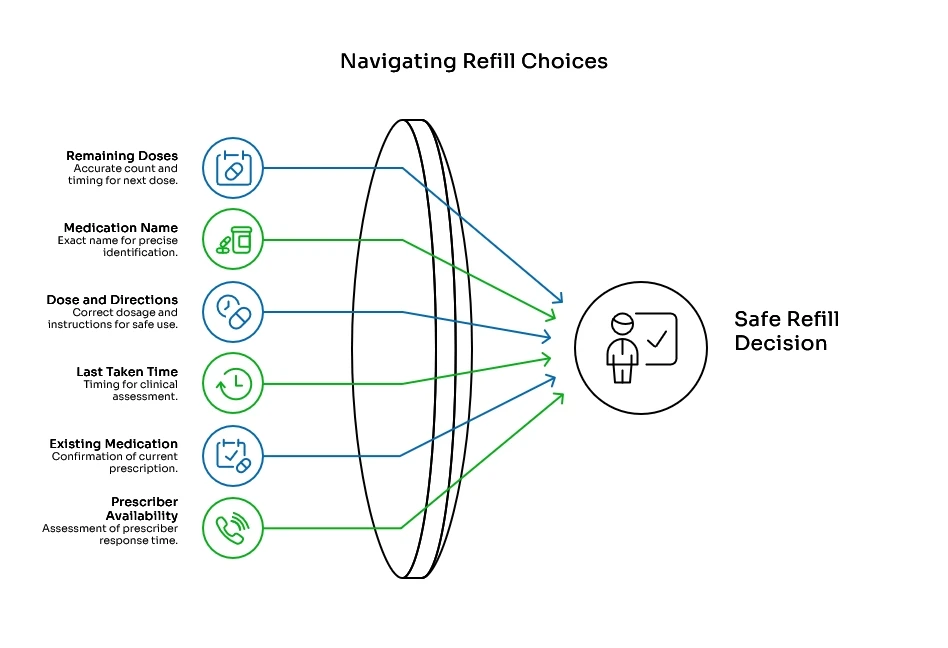
The first step is not to panic; it is to sort what can wait from what needs a safer next step.
Use this checklist before choosing a refill path:
- Count remaining doses. Write down how many are left and when the next dose is due.
- Confirm the medication name. Use the exact name on the label.
- Check the dose and directions. Do not rely on a shortcut like “the small white pill.”
- Note when you last took it. This helps a clinician understand the timing.
- Confirm it is an existing medication. Bridge refill help is generally for medications you already take, not new starts.
- Check whether your regular prescriber can respond in time. Look at office hours, portal messages, refill line instructions, and upcoming appointments.
- Watch for urgent symptoms or safety concerns. If you feel unsafe, have severe symptoms, or are unsure whether waiting is safe, seek urgent or emergency care.
- Consider whether a clinician-reviewed bridge path fits the gap. This may be appropriate only when the medication and situation can be reviewed safely.
That is the whole first move. Count, gather, check, decide.
Mini-Flowchart: Enough Left, Nearly Out, or Already Out
Enough medication left Prepare your details now. Contact your regular prescriber when available. Set a reminder so the next refill starts earlier than the last-dose moment.
Nearly out Gather the label details, last-dose timing, and local fulfillment destination. Check whether your regular care team can respond before the next missed dose. If not, consider whether a clinician-reviewed temporary bridge path may fit.
Already out Pause before deciding to wait. Look for symptoms, safety concerns, or medication-specific risks that may need urgent care. If the situation is not an emergency but the gap still needs attention, a clinician-reviewed bridge refill may be one possible next step for an existing medication.
This flowchart is not a diagnosis. It is a way to stop the spiral and make the next decision cleaner.
What to Gather Before You Choose a Refill Path
Preparation makes review safer.
Before you submit any request, message your regular prescriber, or seek bridge care, gather the details a clinician would need to understand the situation. A clear photo of the medication label may help you avoid typos. So can writing the information in one note on your phone.
Include the medication name, strength, directions, last dose taken, remaining doses, prescriber name if available, and any recent medication changes. Also note where you can receive local fulfillment if an e-prescription is appropriate.
Keep this factual. This is not the moment to stretch doses, borrow medication, or improvise based on advice meant for someone else. General health principles support keeping an accurate medication list and sharing it with healthcare professionals, but the right next step may vary by medication and medical history.
If privacy is part of your concern, it is reasonable to look for clear statements about how a service handles health information. The U.S. Department of Health and Human Services explains patient rights around access to health information through its HIPAA guidance, and online healthcare services should be transparent about privacy and security practices.
When Waiting May Be Reasonable—and When It May Not Be
Waiting may be reasonable when you still have enough medication, your regular prescriber can respond soon, and you have no symptoms or safety concerns. That is a general principle, not a guarantee.
Waiting may be less reasonable when you are already out, the next dose is due soon, the medication is important for ongoing stability, or you are unsure what could happen if you miss doses. Some situations also require urgent or emergency care rather than a refill pathway. Severe symptoms, chest pain, trouble breathing, thoughts of self-harm, signs of a serious allergic reaction, or any situation that feels unsafe should not be handled through a routine refill request.
The hard part is not always the bottle. It is the uncertainty.
That is why the safest sequence is preparation first, then boundaries, then action. A fast option is only helpful if it still includes clinician review and clear limits.
What a Clinician-Reviewed Bridge Refill Can—and Cannot—Do
A bridge refill is temporary support for a gap in care. It is not a replacement for your primary care doctor.
A clinician-reviewed bridge refill can help when the medication is an existing prescription, the request can be reviewed safely, and the goal is temporary continuity until regular care resumes. The phrase “clinician-reviewed” matters because approval is not automatic.
A bridge refill cannot diagnose an acute condition, start a new medication, guarantee approval, or replace ongoing care. Some medications may also be excluded because they require closer monitoring or are not appropriate for this kind of refill pathway.
Those limits are not obstacles. They are trust signals.
How Refill Genie Fits the Decision Path
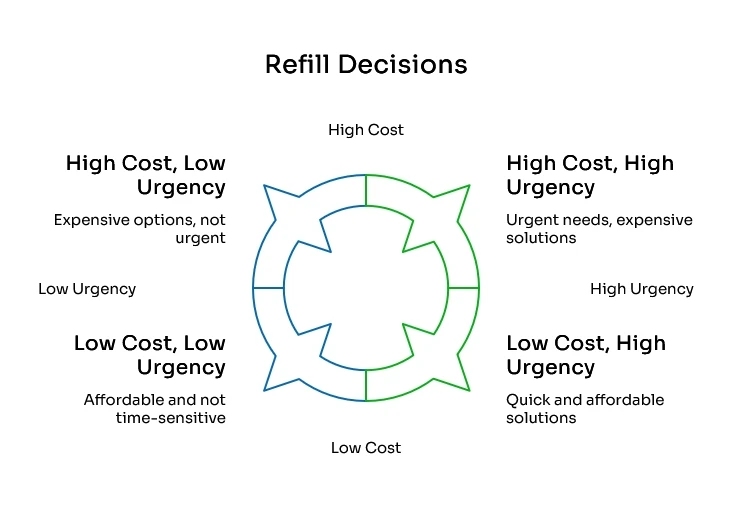
If your checklist points toward a possible bridge path, Refill Genie may be one option to review. The service uses a short intake, text-based clinician review, and e-prescription routing if the refill is clinically appropriate. You can learn more about the process through Refill Genie’s online prescription refill page.
Refill Genie aims for a doctor text response within a maximum of 12 hours, with many requests completed within 2–3 hours. Please note that these timeframes are estimates based on clinical demand and should be understood as process guidance, not a guarantee. This service is not a substitute for emergency care. If the situation feels urgent or unsafe, seek urgent or emergency care.
Refill Genie charges a service fee of $59 for a 90-day script covering up to 3 existing medications. This fee covers clinician review and e-prescription transmission if a bridge refill is deemed clinically appropriate. It does not include the local fulfillment charge, which can vary.
Legitimacy also matters when choosing online care. Readers can review online healthcare verification through the LegitScript website checker. For a broader safety check, Refill Genie’s article on safe online refilling may also help.
After the Immediate Gap: Make the Next Refill Easier
Once the immediate refill gap is handled, the next goal is preventing the same bottle-rattle moment from happening again.
Set a refill reminder well before the final week. A 9-day cushion is often easier to manage than a same-night scramble. Save a clear photo of your current label, keep your regular prescriber’s contact information in one place, and ask about renewal timing at your next appointment.
Then reconnect with regular care. Bridge care can help with a temporary gap, but ongoing medication management belongs with a clinician who can follow your long-term health, monitor changes, and adjust treatment when needed.
That is the calmer path forward: regular care when available, temporary bridge support when appropriate, and urgent care when safety requires it.
The empty bottle does not have to control the next 12 hours. Count what is left. Gather the facts. Check the boundaries. Choose the safest next step.
Clear bottle. Clear facts. Clear next move.
Disclaimer: This article is for informational purposes only and does not provide individualized medical advice, diagnosis, or treatment. If you have severe symptoms, feel unsafe, or are unsure whether waiting is safe, contact a licensed clinician or seek urgent or emergency care.
Our Editorial Process:
Our expert team uses AI tools to help organize and structure our initial drafts. Every piece is then extensively rewritten, fact-checked, and enriched with first-hand insights and experiences by expert humans on our Insights Team to ensure accuracy and clarity.
By: The Refill Genie Insights Team
The Refill Genie Insights Team is our dedicated engine for synthesizing complex topics into clear, helpful guides. While our content is thoroughly reviewed for clarity and accuracy, it is for informational purposes and should not replace professional advice.