
June 16, 2026
Records to Gather Before Requesting an Online Refill for a Chronic Medication
📌 Key Takeaways
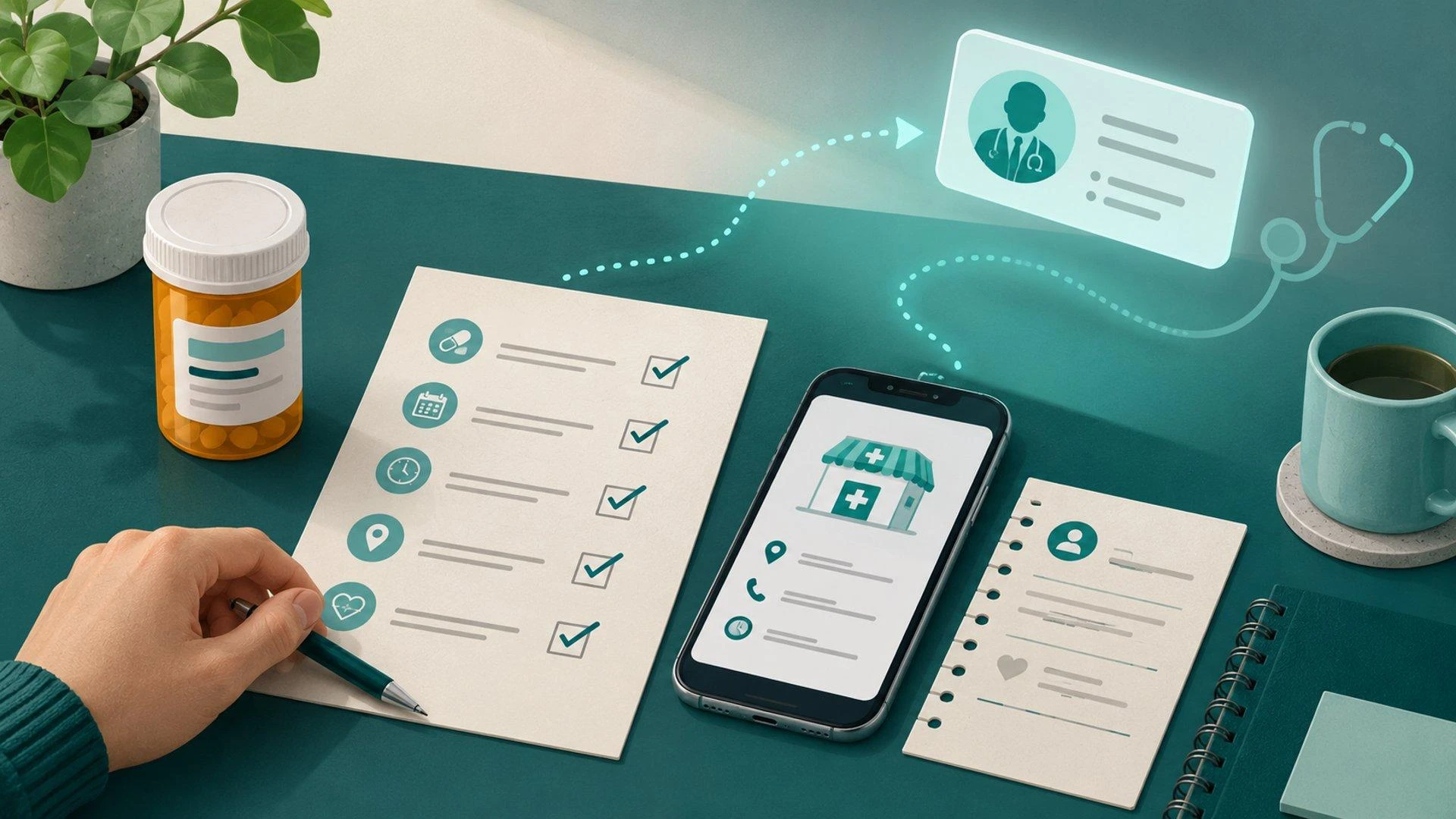
Online refill requests work best when your medication details, health changes, and pharmacy information are ready before you start.
- Gather Details First: Confirm the medication name, strength, dose, schedule, and pharmacy before opening the request form.
- Use Real Records: A bottle label, pharmacy portal, or visit summary helps prevent wrong or outdated answers.
- Share Health Changes: New symptoms, side effects, dose changes, or hospital visits may affect the clinician’s review.
- Check Pharmacy Info: The right pharmacy name, address, and phone number help avoid sending prescriptions to the wrong place.
- Expect Clinical Review: Complete records may speed intake, but the clinician still decides whether a refill is appropriate.
Prepared records support a cleaner request, but they cannot replace medical judgment.
Adults managing ongoing prescriptions will get a clear preparation checklist here, preparing them for the detailed overview that follows.
~ ~ ~ ~ ~ ~ ~ ~ ~ ~ ~ ~ ~ ~ ~ ~ ~ ~
Starting an online refill request only to realize you cannot answer a basic question — the medication strength, the exact directions on the label, the pharmacy phone number, or the name of the clinician who last prescribed it — is a frustrating way to lose time. That pause rarely causes an immediate crisis, but it can result in incomplete answers that prompt follow-up questions from the reviewing clinician.
The following checklist outlines the records required to complete an online refill request efficiently, acknowledging that clinician requirements vary by medication, health history, and specific circumstances, because what a clinician may ask for can vary depending on the medication, health history, and circumstances of the request.
Quick Answer: What to Gather First
For most chronic or maintenance medication refill requests, the records that are commonly useful include the medication name (brand and generic), strength and dosage form, current dose and schedule, the prescription label or a photo of the bottle, the last fill date, the remaining doses, the prescribing clinician’s name, the preferred pharmacy’s full details, known allergies and side effects, and any recent changes in health status or dosing. Relevant lab or monitoring results may also help, depending on the medication. Having these details on hand before starting reduces the chance of stopping to search mid-process.
Online Refill Readiness Checklist
The table below covers the records and details commonly useful before submitting an online refill request. Items are framed as preparation guidance — not universal requirements — since what a reviewing clinician may ask for can vary by medication and situation.
| Record or detail | Where to find it | Why it may help | Important caveat |
|---|---|---|---|
| Medication name (brand and generic) | Prescription bottle label, pharmacy portal, patient portal, or prior visit summary | Brand and generic names differ; having both reduces confusion | Do not guess if you are unsure of the spelling |
| Strength and dosage form (e.g., 10 mg tablet) | Bottle label, medication package, pharmacy records | Helps identify the exact version of the medication | The same medication may come in more than one strength or form |
| Current dose and schedule | Label directions, clinician instructions, patient portal | Shows how you currently take the medication | Use the most recent instructions if the dose recently changed |
| Prescription label or bottle photo | Current or most recent prescription bottle | May show medication name, strength, directions, prescriber, pharmacy, and fill date in one place | A label can support review but does not guarantee approval |
| Last fill date and estimated doses remaining | Bottle label, pharmacy app, pill organizer, calendar | Helps the clinician understand refill timing | If the count is uncertain, say so honestly |
| Prescribing clinician’s name | Prescription label, patient portal, or prior appointment notes | Gives context for the existing prescription history | The original prescriber may no longer be available; include the name regardless |
| Preferred pharmacy name, address, and phone number | Pharmacy website, app, label, or map listing | Helps reduce routing errors if a prescription is appropriate | Confirm the exact location, especially after moving or traveling |
| Known allergies and medication reactions | Personal health notes, pharmacy profile, prior records | Relevant to safety review during clinician assessment | Include side effects even if you are unsure they are related |
| Recent health changes (new diagnosis, hospitalization, dose change) | Clinician messages, visit notes, discharge summary, personal notes | Recent changes may affect whether online review is appropriate | Do not omit changes because they seem unrelated |
| Relevant labs or monitoring results (if applicable) | Lab portal, patient portal, or paper results | Useful for medications that may require monitoring or recent clinical context | Not every medication requires labs — only relevant to certain cases |
If you are close to running out, the related guide on what to check before you wait may help you organize the immediate details before deciding what to do next.
Why Accurate Medication Details Matter
A chronic medication is any drug taken on an ongoing basis to manage a long-term health condition — also called a maintenance medication. An existing prescription is one already issued by a licensed clinician, as distinct from a new medication being prescribed for the first time. A refill request asks whether continuing that existing medication may be appropriate after review.
Medications that treat similar conditions sometimes share names, appear in multiple strengths — the amount of active ingredient per dose, such as 10 mg or 25 mg — or come in different dosage forms, including tablets, capsules, inhalers, patches, and liquid measures, each with different dosing frequencies. A description like “one a day” may not capture which formulation you are currently taking or whether your clinician recently adjusted the schedule.
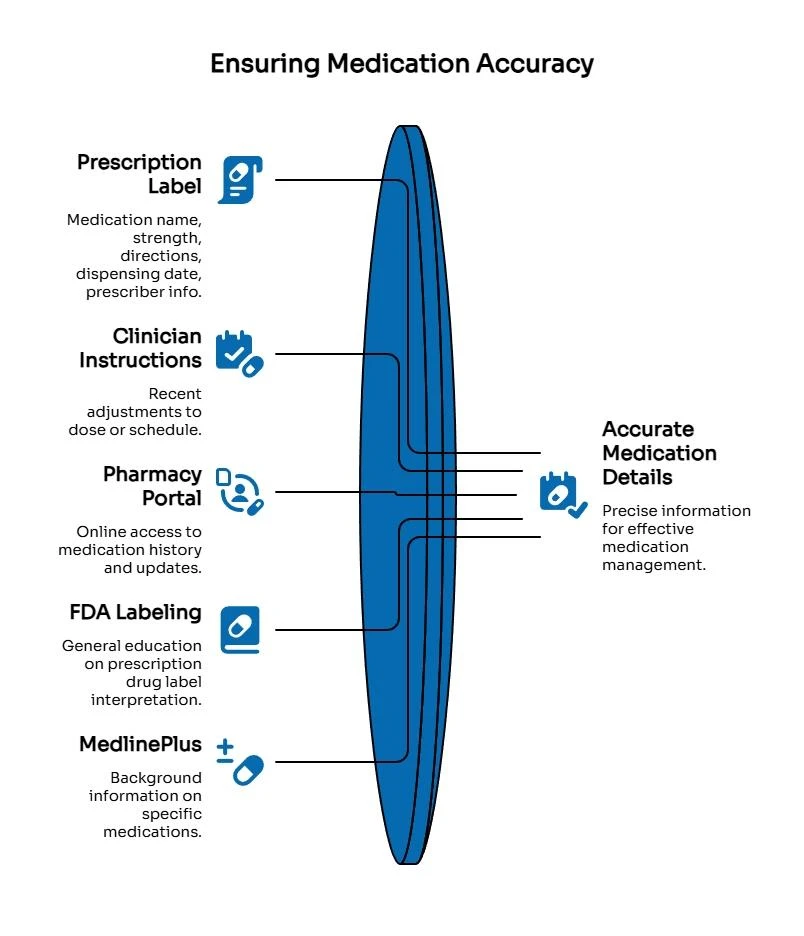
Here is a practical example: before starting an online request, you check the prescription bottle. The label shows the medication name, the strength in milligrams, the directions as originally written, the dispensing date, and the prescriber’s contact information — answering most of the intake questions without any guesswork. Relying on memory alone risks entering an outdated strength or dose frequency, which can prompt a follow-up from the reviewing clinician.
If your label is outdated because the dose changed, locate the most recent clinician instructions or check your pharmacy portal before starting. The FDA provides patient labeling resources for general education on prescription drug labels, and MedlinePlus offers a medicine information resource for background on specific medications.
Health History Details That May Affect Review
An online refill request is not only about the medication bottle. Depending on the medication and your situation, health context matters too. Disclosing recent changes accurately supports better review — not because it guarantees any outcome, but because it gives the clinician the information needed to assess the request responsibly.
Details that are commonly relevant include newly developed allergies or medication reactions, new diagnoses, recent hospitalizations, recent dose adjustments, pregnancy status where relevant, and significant changes in symptoms. If a new prescription, supplement, or over-the-counter product has been started or stopped since the last refill, that context may also be useful to share.
A recent dose change deserves particular attention. If your clinician increased your daily dose after the last bottle was filled, your old label now conflicts with the updated instructions. Before submitting an online refill request, locate the newer portal message or visit summary so the intake form reflects your current regimen. That single step prevents a mismatch that might otherwise generate follow-up questions.
Be honest about side effects, missed doses, and recent symptoms. Leaving out information makes the request less accurate — and less useful for the clinician reviewing it.
Pharmacy and Prescriber Information to Keep Handy
Two logistical details that are easy to overlook are your current pharmacy information and the prescribing clinician’s name. If a prescription is appropriate, it may need to be transmitted electronically — as an e-prescription — to a local pharmacy. Confirming the full pharmacy name, street address, phone number, and store number if available before submitting ensures the e-prescription reaches the right location.
This step is especially important if you recently moved to a new city, are traveling, or use a chain pharmacy with multiple nearby locations. Confirming the new pharmacy’s full address and phone number before submitting takes under a minute and prevents a prescription from being sent to a former location.
Prescriber details can also help. Keep the prescribing clinician’s name, practice name if known, and approximate last visit date nearby. If the original prescriber is no longer available due to a practice change, retirement, or a gap between providers, the name from the prescription label or patient portal is still worth including. Prior refill history, if accessible through a pharmacy or patient portal, can help establish that this is an existing, ongoing prescription rather than a new medication start.
For a full overview of the online prescription refill process, RefillGenie’s online prescription refill page explains each step in detail.
Records Cannot Guarantee Approval
Useful records support clinician review. They do not replace it.
Gathering medication details and health history supports the intake process, but approval depends on the clinician reviewing the request — not on the completeness of documentation alone. RefillGenie states that it does not diagnose acute conditions or start new medications. A clinician may determine that an online refill is not appropriate depending on the medication type, current health status, or other clinical factors that emerge during review.
Some medications are excluded from online refill services due to safety protocols and federal regulations, such as the Ryan Haight Act, which restricts the online prescribing of controlled substances. RefillGenie excludes these categories, including controlled substances, sedatives, muscle relaxants, GLP-1 injections, erectile dysfunction medications, hormone replacement therapy, and medications requiring close monitoring, regardless of documentation.
RefillGenie describes itself as a temporary bridge — not a replacement for a primary care doctor — designed for situations such as being between providers, traveling, or unable to secure a timely appointment for an existing medication. Re-establishing ongoing care with a local clinician remains an important parallel step. Readers evaluating whether an online refill service is legitimate can review resources such as LegitScript certification. Additionally, patients should verify that the service and the associated pharmacy are properly licensed in their state by consulting their local state board of pharmacy or the National Association of Boards of Pharmacy (NABP).
When to Seek Urgent or In-Person Care
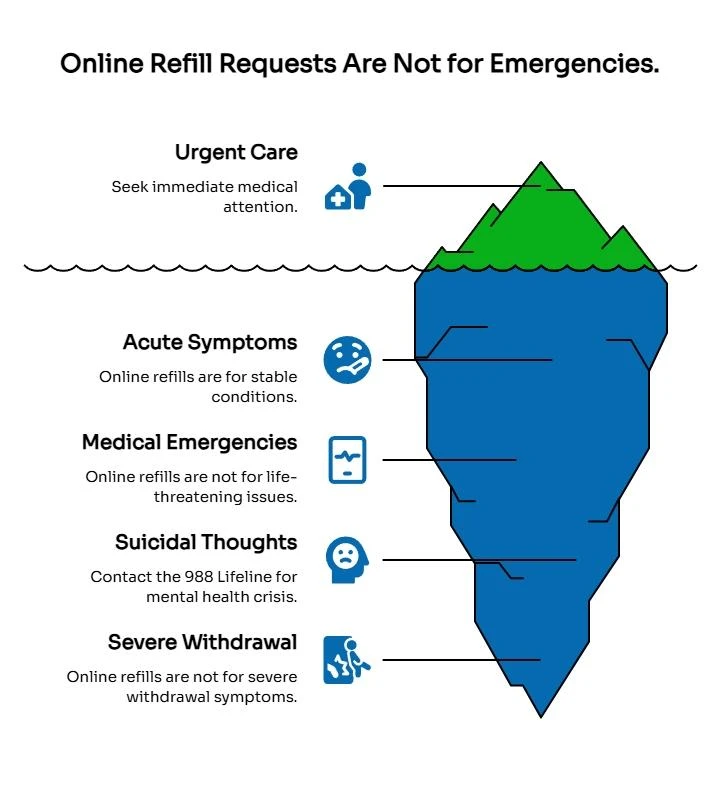
An online refill request is designed for stable, existing medication situations — not for acute symptoms or medical emergencies. If you have chest pain, difficulty breathing, symptoms of a serious allergic reaction, suicidal thoughts, severe withdrawal concerns, or another urgent concern, seek urgent or emergency care rather than submitting a refill request.
If you are in the U.S. and experiencing suicidal thoughts or a mental health crisis, the 988 Suicide & Crisis Lifeline is available by call or text at any time. For general guidance on recognizing when emergency care is needed, MedlinePlus offers a resource on when to use the emergency room.
No amount of preparation makes an online refill request appropriate for an urgent or emergency situation.
How to Use Your Records During a Request
Keep your records nearby while answering intake questions. Use the exact wording from the prescription label, pharmacy portal, or clinician instructions when possible, rather than working from memory.
If something has changed, say so clearly — that includes dose changes, new symptoms, side effects, missed doses, new medications, or a recent hospitalization. If you do not know an answer, it is safer to say you are unsure than to guess.
A practical preparation sequence: confirm the medication name, strength, and directions; count or estimate remaining doses; verify the preferred pharmacy’s full address and phone number; note any recent health changes; then keep your phone available in case the reviewing clinician contacts you by text.
If your doctor’s office is closed or timing is a concern, the guide to weekend prescription refill options can help you think through next steps without treating every situation the same.
Frequently Asked Questions
Do records guarantee that a refill request will be approved?
No. Records support the review process, but approval depends on clinician judgment, medication type, safety considerations, and eligibility rules. Documentation helps the review proceed with accurate information — it does not determine the outcome.
Is the prescription bottle required to submit a request?
It may be helpful because the label can show the medication name, strength, directions, prescriber, pharmacy, and fill date in one place. The same information found in a pharmacy portal or prior visit summary serves the same purpose. Treat the bottle as a useful reference, not proof that a refill will be approved.
What if you cannot recall the medication strength?
Check the prescription label, pharmacy portal, patient portal, or a prior visit summary. If you still cannot confirm it, do not guess. Provide the information you can verify and explain what you are unsure about.
Should you disclose recent side effects or symptoms?
Yes. Disclosing them honestly gives the reviewing clinician accurate context. If symptoms are severe, urgent, or unfamiliar, seeking urgent or emergency care is more appropriate than submitting a refill request.
Is it possible to request a refill for a new medication?
RefillGenie states that it does not diagnose acute conditions or start new medications. Online refill services of this type are intended for existing prescriptions only.
Prepare Clearly, Then Let the Clinician Decide
Taking a few minutes to locate the prescription label, confirm pharmacy details, and note any recent health changes before starting a request makes the intake process more efficient — and gives the reviewing clinician a clearer, more complete picture of the situation.
What those records cannot do is determine the outcome. That belongs to the clinician. Approaching the process with accurate information and realistic expectations is the most useful starting position.
When you are ready to move forward, check whether your medication may be eligible for a refill and gather the relevant details before beginning your online prescription refill request.
Disclaimer: This article is for general informational purposes only and does not constitute medical advice, diagnosis, or treatment. Readers should consult a licensed healthcare professional for guidance specific to their health, symptoms, medications, or treatment options.
Our Editorial Process:
Our expert team uses AI tools to help organize and structure our initial drafts. Every piece is then extensively rewritten, fact-checked, and enriched with first-hand insights and experiences by expert humans on our Insights Team to ensure accuracy and clarity.
By: The Refill Genie Insights Team
The Refill Genie Insights Team is our dedicated engine for synthesizing complex topics into clear, helpful guides. While our content is thoroughly reviewed for clarity and accuracy, it is for informational purposes and should not replace professional advice.