
January 20, 2026
Weekend Refill Panic: What to Do When Your Doctor's Office Is Closed
📌 Key Takeaways
Weekend medication gaps happen when administrative systems fail, not when patients fail—legitimate pathways exist to restore continuity fast.
- Five-Minute Triage Wins: Gathering prescription numbers, pharmacy details, and prescriber contact information before panic sets in accelerates every refill pathway available.
- State Rules Vary Widely: Pharmacists can dispense emergency supplies in many states, but controlled substances are universally excluded and duration limits differ significantly by location.
- Legitimacy Markers Matter: Clinician review, HIPAA compliance, transparent pricing, and local pharmacy e-prescribing distinguish safe online refill services from risky shortcuts.
- Match Risk to Site: Urgent care handles developing symptoms and higher-risk medications; emergency rooms are reserved for red flags and medications where interruption is dangerous.
- Prevention Beats Reaction: Calendar reminders 7-10 days before running out, digital medication cards, and carry-on-only travel packing eliminate future weekend crises.
Prepared = faster refills and uninterrupted treatment.
Busy professionals managing maintenance medications between appointments or insurance transitions will find immediate decision-making clarity here, preparing them for the detailed pathway comparisons that follow.
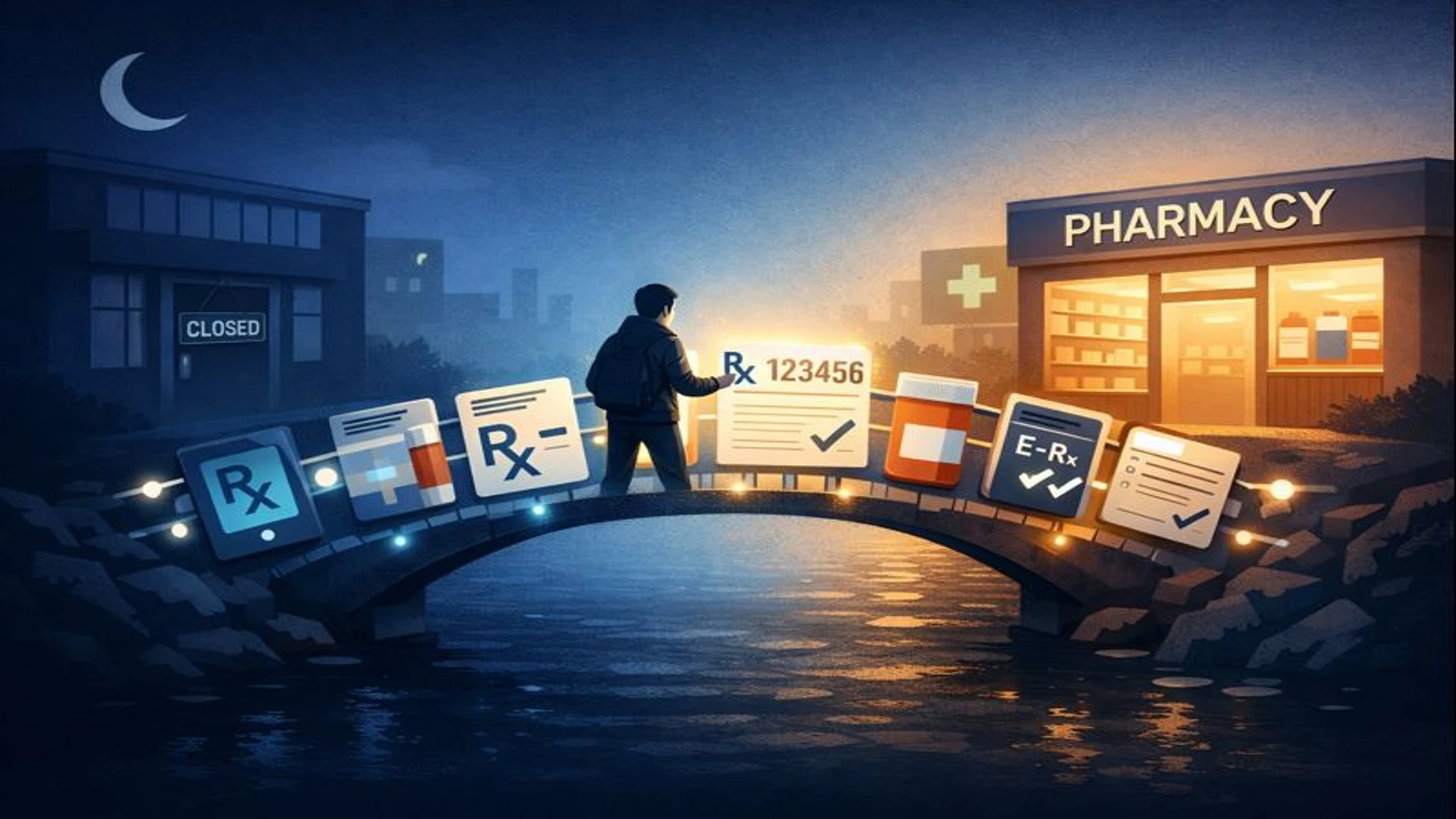
It’s 8 PM on a Friday when you shake your pill bottle and hear nothing. Your doctor’s office closed hours ago, and you won’t be able to reach them until Monday morning—maybe later if appointments are backed up. The familiar tightness in your chest isn’t just anxiety about running out; it’s the very real concern about what happens when you miss even a few doses of your maintenance medication.
This situation isn’t your fault. The “Friday Night Panic” often results from the misalignment between traditional office hours and modern life. Administrative scheduling creates unintended gaps in essential care, meaning you need legitimate options that won’t break the bank or waste critical healthcare resources.
Emergency Medication Refill is the provision of immediate, short-term prescription refills for maintenance medications to prevent treatment gaps. Think of it as a spare tire for your health; it’s not meant to replace the wheel forever, but it keeps you moving safely until you get to the shop. Imagine the relief of knowing that a lost bottle of pills won’t result in a week of brain zaps or anxiety—you have a backup plan in your pocket. You should use this service to bridge the gap between doctor’s appointments or during unexpected travel.
Here’s your fast-action plan for handling this weekend crisis safely and efficiently.
First: Do These 5 Checks in the Next 15 Minutes
Before you panic or make any hasty decisions, gather the information that will speed up whichever option you choose. This triage process helps you reduce risk and identify the fastest path forward.
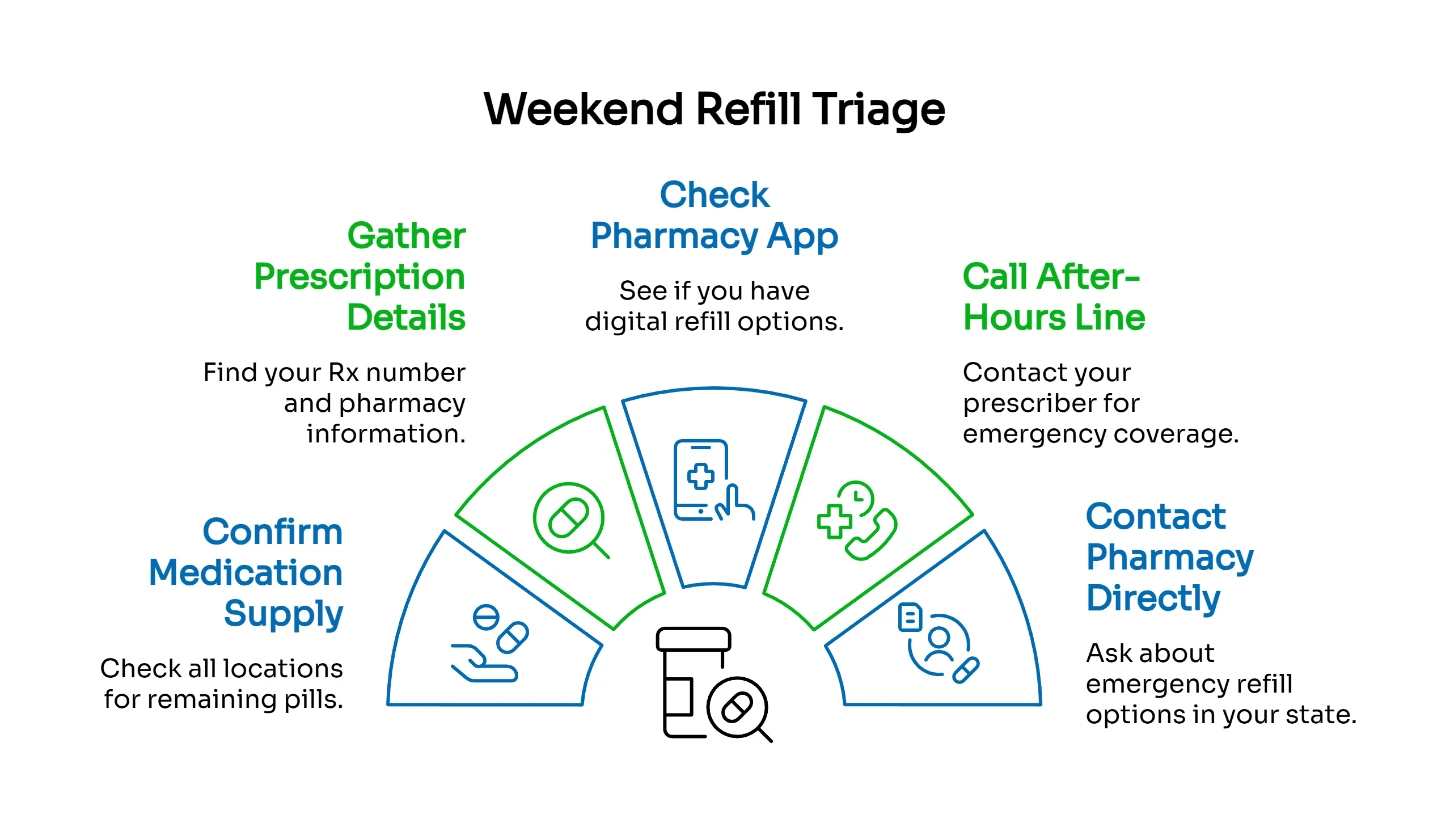
Your immediate checklist:
- Confirm your last dose and what you have left. Check every pocket, bag, and medicine cabinet. Sometimes pills end up in unexpected places. Even a partial fill matters.
- Check the bottle label for your Rx number and pharmacy information. You’ll need the prescription number, medication name and strength, and pharmacy location for any refill request.
- Open your pharmacy app or patient portal to see if you have remaining refills. Many prescriptions come with multiple refills that you might have forgotten about, and some portals allow you to request refills digitally.
- Call your prescriber’s after-hours line if one exists. Some practices have emergency coverage or answering services that can authorize refills for established patients. Leave a clear message with your Rx number and preferred pharmacy.
- Contact your pharmacy directly to ask what emergency options exist in your state. Pharmacists have more authority than most people realize, and state rules vary considerably.
Critical safety guidance: If you’re experiencing severe symptoms, feel unsafe, or take a medication where sudden interruption could be dangerous (such as blood pressure medication, anti-seizure drugs, or blood thinners), seek urgent or emergency care immediately. Don’t wait for a refill authorization if your health is deteriorating. And never double-dose to “catch up” or try to stretch your supply by skipping doses—both approaches can create serious medical risks. Waiting until Monday can cause withdrawal symptoms that impact work performance, so taking action this weekend is often medically necessary, not optional.
Your Weekend Refill Options at a Glance
Make the decision in 30 seconds with this comparison:
| Option | Speed | Typical Cost | Hassle Level | Best For | Watch-Outs |
|---|---|---|---|---|---|
| Wait Until Monday | 2-3 business days | Insurance copay ($5-$50) | Low once office opens | Low-risk medications where a brief gap is medically safe and symptoms are absent | Not appropriate for medications requiring daily consistency; withdrawal can affect work performance |
| Pharmacy Emergency Supply | 30 minutes - 2 hours | Retail med cost + possible dispensing fee | Low if pharmacist approves | Established prescription history with that specific pharmacy | State rules vary; often limited to a few days; controlled substances commonly excluded |
| Online Refill Service | 2-12 hours | Service fee (around $60) + pharmacy cost | Very low; text-based | Maintenance medications when offices are closed and you have documentation available | Not for new medications or acute diagnosis; controlled substances often excluded |
| Urgent Care | 1-4 hours wait time | $100-$200+ visit fee | Medium; requires in-person visit | Developing symptoms, higher-risk medications, or uncertainty needing clinician evaluation | May decline certain refills; may require documentation; not ideal for routine administrative refills |
| Emergency Room | Varies widely | $500-$3,000+ | High; long waits for non-emergencies | Red flags, severe symptoms, or high-risk medications where interruption can be dangerous | Reserve for true emergencies; exorbitantly expensive for routine refills |
“RefillGenie is the best! I cannot say enough good things about this company! When I was unable to see my primary physician, to get my recurring meds refilled, RefillGenie was there for me.” — Toby S.
Option 1: Ask Your Pharmacy About an Emergency Supply
Pharmacists can sometimes bridge small gaps, though rules vary significantly by state. Many states allow pharmacists to dispense a limited emergency supply—typically 72 hours to 30 days—when you have an established prescription on file and can’t immediately reach your prescriber.
What you need to request an emergency supply:
Your prescription number from the bottle label is the most important piece of information. The pharmacist will also need your medication name and strength, plus your prescriber’s information and pharmacy history. If you’ve filled prescriptions at this pharmacy before, they’ll have most of this information in their system already. Be prepared to explain briefly why your prescriber is unreachable and when you’ll be able to contact them during business hours.
What to expect:
State pharmacy boards set the rules for emergency supplies, and they differ considerably. Some states allow a 72-hour bridge supply for any maintenance medication. Others permit up to a 30-day supply depending on the medication class and your prescription history. The quantity is typically limited—intended as a short bridge to continuity, not a full renewal. Your pharmacist will know what’s permitted in your state and can often process this request within an hour.
The dispensing may involve a small additional fee beyond your medication’s retail cost, though many pharmacies waive this for established customers.
Common blockers:
Controlled substances are almost universally excluded from emergency supply provisions. Medications that require close monitoring of blood levels or specific safety protocols may also be restricted. If your medication falls into either category, you’ll need to pursue one of the other options. If the pharmacist declines, that’s not a dead end—it’s a signal to move to the next safest pathway without delay.
Option 2: Use an Online Prescription Refill Service
A legitimate way to bridge the gap when offices are closed involves connecting with licensed clinicians through secure digital platforms. Online Prescription Refill is a digital telemedicine service connecting patients with clinicians for the purpose of renewing existing prescriptions. It is like online banking for your health—skipping the line at the teller to get your essential business done. Picture handling your monthly health admin in 5 minutes via text instead of taking half a day off work for an appointment. Create an account to manage your routine medications efficiently.
Telehealth services operate 24/7 specifically to bridge the weekend gap, making them particularly valuable when traditional office hours create barriers to continuity of care. While clinic visits are vital for new issues, you should switch to online refills for maintenance medications to save time when you’re between appointments or facing administrative delays.
Choosing a Legitimate Service
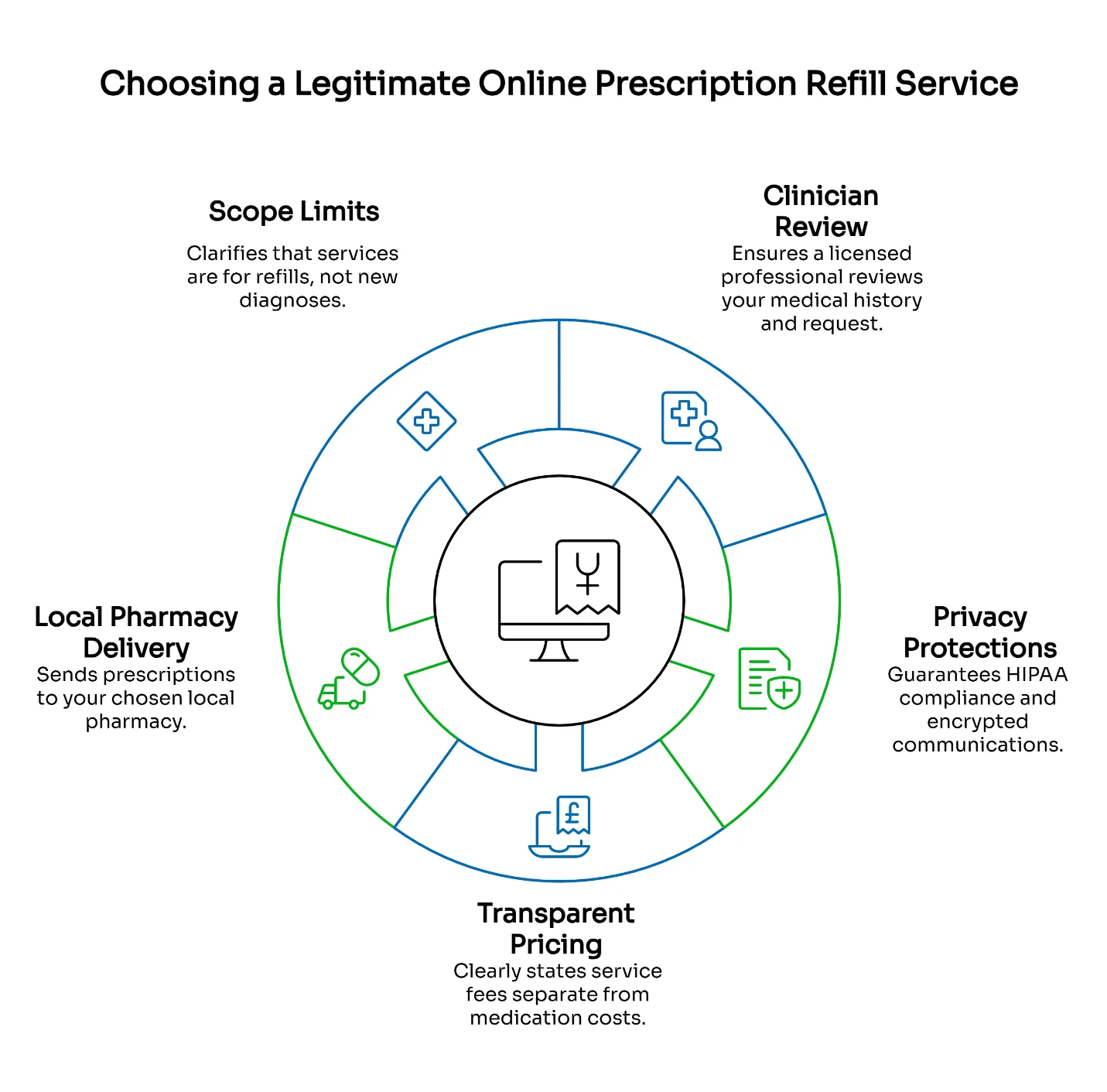
Not all online services meet the same safety standards. Before you submit any medical information, verify that the service follows these essential practices:
Clinician review is mandatory. Legitimate services never offer instant, automated approval. A licensed physician or nurse practitioner must review your medical history and medication request. If you see promises of “instant prescriptions” or “no questions asked,” that’s a red flag.
Privacy protections must be explicit. The platform should clearly state HIPAA compliance and use encrypted forms and messaging for all communications. Your medical information deserves the same protection online as it receives in a traditional office.
Pricing should be transparent. You should know the service fee upfront, separate from what your medication will cost at the pharmacy. Hidden fees or vague pricing structures suggest a service more interested in maximizing revenue than providing legitimate healthcare.
Prescriptions go to your local pharmacy. Trusted services send electronic prescriptions to the pharmacy you choose—they don’t ship mystery medications from unknown sources. You should be able to pick up your prescription at your regular pharmacy, whether it’s a national chain or local independent, just as you would with any other prescription.
Scope limits are clearly stated. Legitimate online refill services do not diagnose acute conditions or start new medications. They exist specifically to bridge gaps in existing care, not to replace comprehensive medical evaluation.
A practical trust check is to verify a healthcare website’s certification status using LegitScript’s verification tool, which monitors online healthcare services for safety and legitimacy.
How Refill Genie Works
Refill Genie operates under a straightforward model designed for exactly this situation. After you complete a brief intake questionnaire about your medical history and current medications, a licensed clinician reviews your information and contacts you directly via encrypted text message. If appropriate for your situation, they transmit an electronic prescription to your local pharmacy.
The service maintains strict safety boundaries. The medical team does not diagnose acute conditions or start new medications—this is exclusively for refilling existing prescriptions when you can’t reach your regular provider. HIPAA-compliant encrypted forms and texting protect your information throughout the process.
Service pricing is transparent at $59 for a 90-day supply review for up to three existing medications. This fee is for the physician review and electronic prescription transmission—it takes the place of an urgent care copay, which typically runs significantly higher. The pharmacy will charge separately for your actual medication, depending on your insurance coverage or retail pricing. For those without insurance or between coverage, understanding the cost of prescriptions without insurance helps with planning.
Patients typically receive a text from a doctor within a few hours. While the service aims to process every request as fast as possible, response times can vary based on demand; however, most requests are completed within 2-4 hours. The service operates 365 days a year from 8 AM to 8 PM, and often outside those hours for urgent situations.
Service coverage varies by state and regulations change frequently. Refill Genie currently operates in a wide network of states across the U.S., but availability is subject to local telemedicine laws. Please visit the service website to confirm if coverage is currently available in your specific location. The physician-founded team created this service specifically to reduce unnecessary emergency room visits for prescription refills and bridge the gaps that occur when patients lose insurance or transition between providers.
Refill Genie does not intend to replace your primary care doctor. It is important to re-establish care as soon as possible with a local provider who can perform regular physical exams and manage your health over the long term. This service exists as a temporary resource to bridge the gaps in care that often occur in times of uncertainty.
If you need to renew a prescription and can’t wait until Monday, this option provides a legitimate pathway to continuity without the expense of urgent care.
“Super easy to use if you need a quick refill! I was really thankful for them this month when my Lexapro ran out and I couldn’t get a hold of my doctor!” — Ivy L.
Option 3: Urgent Care vs. the ER: When Each Makes Sense
Match the site of care to the level of risk. Not every medication gap requires immediate in-person medical attention, but some situations absolutely do. For general guidance on when to choose emergency care versus urgent care, the American College of Emergency Physicians provides practical decision-making guidance.
Urgent care makes sense when:
You’re developing symptoms related to missing your medication, the medication itself is higher-risk and you can’t safely wait until Monday, or there’s uncertainty that needs a clinician’s assessment the same day—but the situation doesn’t feel like an emergency. Urgent care centers can evaluate your situation, check basic vital signs if needed, and write a prescription to bridge you until you can reconnect with your regular provider. The visit typically costs $100-$200 without insurance—less than an ER but more than online options.
The limitation is that urgent care providers don’t have your complete medical history. They’re working with whatever information you can provide verbally and whatever prescription bottles you brought with you. For straightforward maintenance medications, this usually works fine. For complex medication regimens or situations requiring coordination with specialists, the lack of historical context can be challenging.
The emergency room is appropriate when:
You’re experiencing red flag symptoms, severe withdrawal effects, or take a medication where interruption could be genuinely dangerous. If you take insulin, anti-seizure medications, blood thinners, or certain psychiatric medications where sudden discontinuation carries significant risk, the ER is your safest option.
Emergency departments are high-cost sites of care and should be reserved for emergencies, not routine refills. ER visits for refills are exorbitantly expensive and waste critical resources that should be available for genuine emergencies. The average emergency room visit can easily exceed $1,000 even before any treatment is provided, but that cost becomes irrelevant if the alternative is genuine medical risk.
One important boundary: Never try to “double up” doses to catch up after missing medications. If you’re unsure whether your situation requires immediate in-person care, call your pharmacy and speak with the pharmacist. They can provide medication-specific guidance about what withdrawal symptoms to watch for and when to escalate to urgent or emergency care.
When Waiting Until Monday Is Reasonable
Waiting can be reasonable when three conditions are true:
First, the missed window is short. If you’ll be able to contact your prescriber and pharmacy first thing Monday morning and get your prescription refilled by afternoon, a gap of 2-3 days may be medically acceptable for certain medications.
Second, symptoms are mild or absent. You’re not experiencing any concerning physical or mental health changes related to missing doses. You feel stable and capable of normal daily activities.
Third, the medication is not in a category where interruption is high-risk. Some medications require absolute consistency—insulin, anti-seizure medications, blood thinners, and certain psychiatric medications are examples where interruption can be dangerous and waiting is not safe.
Even when waiting is the right call, treat it as an action plan, not passive delay. Put a Monday morning reminder to call both your prescriber and pharmacy. Keep your Rx number and pharmacy contact information ready. If symptoms escalate over the weekend, step up to urgent care or the ER based on severity.
As clinical context, reputable medical sources note that abruptly stopping certain medications—particularly some antidepressants—can cause discontinuation symptoms. The Mayo Clinic provides patient guidance on antidepressant withdrawal that explains why continuity matters even for seemingly stable medications.
How to Prevent the Next Weekend Scramble
Make this a one-time lesson, not a monthly crisis. A few simple systems can eliminate this stress entirely.
Set up a refill buffer system. Configure calendar reminders on your phone for 7-10 days before you’re due to run out. This gives you enough time to handle insurance issues, prior authorizations, or scheduling delays without panic. The reminder should trigger when you have about a week’s supply left, not on the day you take your last pill. This buffer is particularly important for medications where even brief interruptions can cause withdrawal symptoms that affect your ability to work effectively.
Create a medication card in your phone. Use your notes app or take a photo of your pill bottles with all the relevant information: medication names, dosages, prescriber information, pharmacy name and phone number, and prescription numbers. If you lose your bottle while traveling or need to request a refill from an unfamiliar location, you’ll have everything you need in your pocket. Update this card whenever your prescriptions change.
Plan ahead for travel. Never pack medications in checked baggage—only carry-ons. Checked bags get lost, delayed, or routed to the wrong destination. Keep medications in their original bottles with prescription labels visible to avoid any issues going through security. If you’re traveling to a different state for more than a few days, know that you can request prescription refills while away from home through licensed services that operate across state lines.
These systems work because they shift you from reactive crisis mode to proactive health management. When you have clear systems in place, running out of medication on a weekend becomes almost impossible rather than a recurring source of stress.
“Was so extremely easy to get my blood pressure meds while in between docs! Thank you!” — Mrs J.
FAQ
Can a pharmacy give you an emergency refill when your doctor is closed?
Sometimes. Policies vary by state and medication class, and the decision depends on the pharmacy’s records and the pharmacist’s professional judgment. Many states allow pharmacists to dispense limited emergency supplies when you have an established prescription history, but controlled substances are commonly excluded.
What information do I need to request a weekend refill?
The prescription number from your bottle label, the medication name and strength, the pharmacy where it was last filled, and any documentation showing an established prescription history. If using an online service, be prepared to answer questions about your medical history and why you’re unable to reach your regular provider.
Can urgent care refill a maintenance medication?
It may be possible, but results vary. Urgent care is most appropriate when symptoms are developing or when waiting is not safe—expect to provide documentation and expect limitations for certain medications. Some urgent care centers may decline refill requests for medications that aren’t urgent or that require your full medical history.
Will an online refill service prescribe new medications?
No. Legitimate services operate under strict scope limits: refilling existing medications only, with no new diagnoses and no starting new medications. If you need a new prescription or diagnosis, you’ll need a comprehensive evaluation with a provider who can perform a full assessment.
What medications typically cannot be refilled online?
Controlled substances are a common exclusion due to federal regulations. Medications that require close monitoring of blood levels may also be excluded or require additional safety steps. Each service will have specific formulary restrictions based on clinical safety protocols.
How fast can an online refill be sent to my pharmacy?
Response times vary by service. Most reputable platforms aim to complete reviews and send electronic prescriptions within a few hours, though timing can depend on demand. Once the prescription is sent electronically to your pharmacy, it’s typically ready for pickup within 30 minutes to an hour.
What should I do if I’m traveling or in a different state?
Start with the pharmacy where your medication is typically filled to ask about emergency options, then move to an online refill pathway if appropriate. Many licensed telehealth services operate across multiple states and can send prescriptions to local pharmacies near your current location. State rules and service availability can differ, so verify coverage before submitting a request.
For additional operational questions, visit our complete FAQ page. If you have specific concerns about your situation, you can also contact us directly.
Medical Disclaimer: This content is for informational purposes only and is not a substitute for professional medical advice, diagnosis, or treatment. Always seek the advice of a qualified health provider with any questions regarding a medical condition or medication. If you think you may be experiencing a medical emergency, call 911 or go to the nearest emergency department.
Our Editorial Process
Our expert team uses AI tools to help organize and structure our initial drafts. Every piece is then extensively rewritten, fact-checked, and enriched with first-hand insights and experiences by expert humans on our Insights Team to ensure accuracy and clarity.
About the Refill Genie Insights Team
The Refill Genie Insights Team is our dedicated engine for synthesizing complex topics into clear, helpful guides. While our content is thoroughly reviewed for clarity and accuracy, it is for informational purposes and should not replace professional advice.