
June 9, 2026
Online Prescription Refill Eligibility When Your Chronic Condition Is Stable

📌 Key Takeaways
Online refills may help stable medication routines, but clinician review still decides what is safe and appropriate.
- Stability Helps, Not Guarantees: A steady dose may support review, but it does not make approval automatic.
- Existing Prescriptions Matter: Online refill care fits current medications better than new treatments or unclear dosing.
- Preparation Speeds Review: Clear labels, pharmacy details, refill timing, and honest health updates help clinicians assess requests.
- Changes Need Care: New symptoms, side effects, missed doses, or recent hospital visits may need deeper medical review.
- Bridge Care Wisely: Gap-care refills can help during access problems, but they do not replace regular care.
Prepared information helps online refill requests move more smoothly, but medical judgment still comes first.
Adults managing stable chronic conditions will gain clear refill-readiness guidance here, preparing them for the detailed overview that follows.
~ ~ ~ ~ ~ ~ ~ ~ ~ ~ ~ ~ ~ ~ ~ ~ ~ ~
Having a stable medication routine can make an online refill request easier to review — but it does not make approval automatic. Medication type, health history, refill timing, documentation, and clinician judgment all shape whether an online review is appropriate for a given situation. Understanding those factors before starting a request is more useful than assuming stability alone clears the path.
This article explains what may affect eligibility, what to prepare, and when a situation may call for a different kind of care.
What “Stable” May Mean In An Online Refill Review
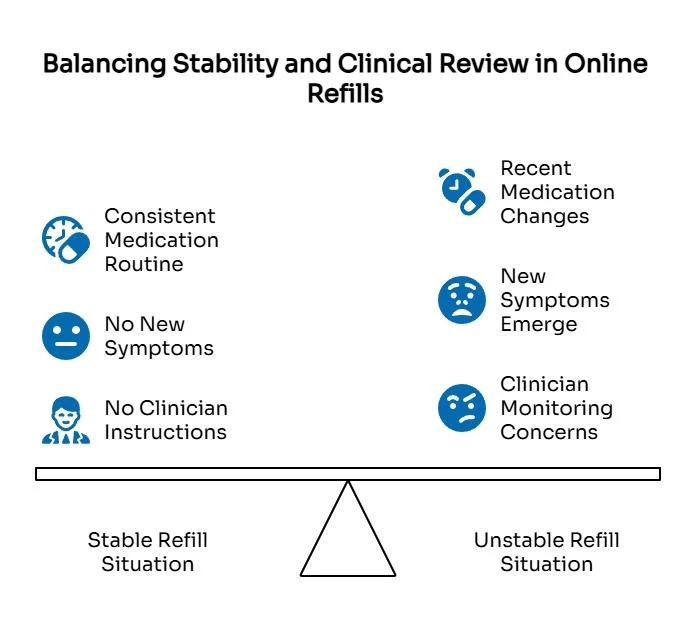
Stability is a practical review factor, not a medical diagnosis or eligibility rule. In a refill-readiness context, a stable situation often means taking the same medication at the same dose for a meaningful period — without recent side effects, new symptoms, or instructions from a clinician to stop, reduce, or more closely monitor the medication.
Consider a busy professional who has been managing a chronic condition for several years on the same maintenance medication. The dose has not changed, no new symptoms have emerged, and the last check-in with a prescribing clinician went without concern. That kind of routine and continuity is generally what online refill review is designed to support.
What stability does not mean is that a clinician reviewing the request will automatically proceed. The full picture still matters: what medication it is, what health changes have occurred since the last refill, whether the timing makes sense, and whether the medication category is one that online review can safely handle. A clinician may ask follow-up questions even when a situation appears routine — and that is an appropriate part of responsible care, not an obstacle to it. For general medication-safety education, MedlinePlus offers helpful guidance on filling prescriptions and using medicines safely.
A useful way to think about stability is this: the more clearly a request looks like a continuation of an existing, unchanged medication routine, the easier it may be for a clinician to evaluate. The more the situation involves new symptoms, uncertain dosing, recent changes, or monitoring concerns, the more likely it is to need deeper review.
Why An Existing Prescription Matters
There is an important distinction between a refill and a new prescription that shapes everything about online refill eligibility. A refill assumes an established relationship: a known medication, a known diagnosis, and a prior clinical decision that this treatment is appropriate. A new prescription requires clinical evaluation — a process that goes well beyond what a text-based online review is designed to do.
Refill timing also plays a role that is easy to overlook. Requesting a refill too early relative to the original prescription dates, or arriving at a service already out of medication with no recent prescription record, can affect how a clinician approaches the review. The strongest position is having an active or recently expired prescription, clear label details, and a consistent medication history — not starting from scratch.
RefillGenie states that its service does not diagnose acute conditions or start new medications. Its process involves answering basic medical-history questions, having a doctor review that information, making direct contact by text, and — if appropriate — transmitting an e-prescription to a local pharmacy. The phrase “if appropriate” is deliberate. Even a request for an existing medication can require follow-up, additional documentation, or redirection to in-person care if the clinical picture warrants it.
The assumption that an existing prescription guarantees a renewal is one of the most common misunderstandings in this space. Having a prescription establishes context; it does not remove the need for review. For more on how the renewal process works, renew a prescription online provides useful context on what to expect.
Online Refill Readiness Checklist: What To Gather Before You Start
Preparation does not guarantee approval, but it gives a reviewing clinician the information needed to make a responsible decision. Gathering the right details before starting a request reduces back-and-forth and helps the process move efficiently.
Before beginning an online refill request, consider having the following ready:
- Medication name, strength, and dosage instructions from the prescription label
- Remaining supply — the number of doses or days left
- Date of last refill and how long the condition and dose have been stable
- Prescribing clinician’s name, if available from records or the bottle
- Pharmacy name and location where the prescription should be sent
- Photos of the prescription bottle or label, if safe and appropriate to submit through the service
- An honest account of recent symptoms, side effects, missed doses, allergies, or new diagnoses since the last refill
- Recent lab results, if the medication requires periodic monitoring
- Notes on any dose changes or uncertainty about the current prescribed amount
- Insurance or payment information — keeping in mind that pharmacy costs are billed separately from the online service fee
- Questions to ask the clinician — anything about the medication, the review process, or next steps worth raising during the text consultation
That last item matters more than it might seem. Online refill services that include direct clinician communication give patients a real opportunity to raise concerns, clarify instructions, or flag anything that has changed. Coming in with a short list of questions makes that exchange more useful for everyone.
The goal of preparation is not to present the cleanest possible case — it is to give the clinician an accurate picture. Omitting recent side effects or downplaying symptom changes in hopes of a smoother review can result in a refill that is not actually appropriate. For further guidance on pre-request preparation, what to check before you wait on a refill walks through a practical checklist including dose counts and label details.
Situations That May Need Deeper Clinical Review Or In-Person Care
A refill can feel routine from the patient’s perspective and still raise clinical questions. That does not mean something is wrong — it means the situation may need more context before a clinician can decide what is appropriate.
New or worsening symptoms are the most important signal. If anything about the condition has changed since the last refill — more frequent episodes, new side effects, increasing severity — that change belongs in a proper clinical evaluation, not a streamlined refill request. Similarly, a recent hospitalization, emergency room visit, or significant health event shifts the clinical context in ways that an online review may not be equipped to assess fully.
Dose uncertainty is another situation worth pausing on. If the current prescribed dose is unclear, if a clinician recently suggested reducing or changing the medication, or if there have been gaps or missed doses that affected how the medication was working, those details need to reach a clinician through a channel with adequate time and tools for evaluation.
RefillGenie’s listed excluded categories provide a useful reference point. Controlled substances, sedatives, muscle relaxants, GLP-1 injections, erectile dysfunction medications, hormone replacement therapy, and medications requiring monitoring are excluded — as are any medications a reviewing doctor determines are unsafe to refill in this format. These exclusions exist because the online refill pathway is designed for straightforward continuity, not clinical complexity.
| A request may be easier to review when… | More review may be needed when… |
|---|---|
| The medication is already prescribed | The medication would be new |
| The dose has not recently changed | The dose changed or is unclear |
| Symptoms are stable or unchanged | Symptoms are new, worse, or severe |
| The medication does not require close monitoring | Labs or close follow-up may be needed |
| Prescription details are clear | Key medication details are missing |
| No recent hospitalization or ER visit | Recent hospitalization or ER visit |
For severe, sudden, or potentially life-threatening symptoms, do not use an online refill service as a first response. MedlinePlus provides general guidance on recognizing medical emergencies. When symptoms are severe, urgent, or potentially dangerous, seek urgent or emergency care rather than waiting for a refill review.
Why Clinician Review Still Matters, Even For Routine Refills
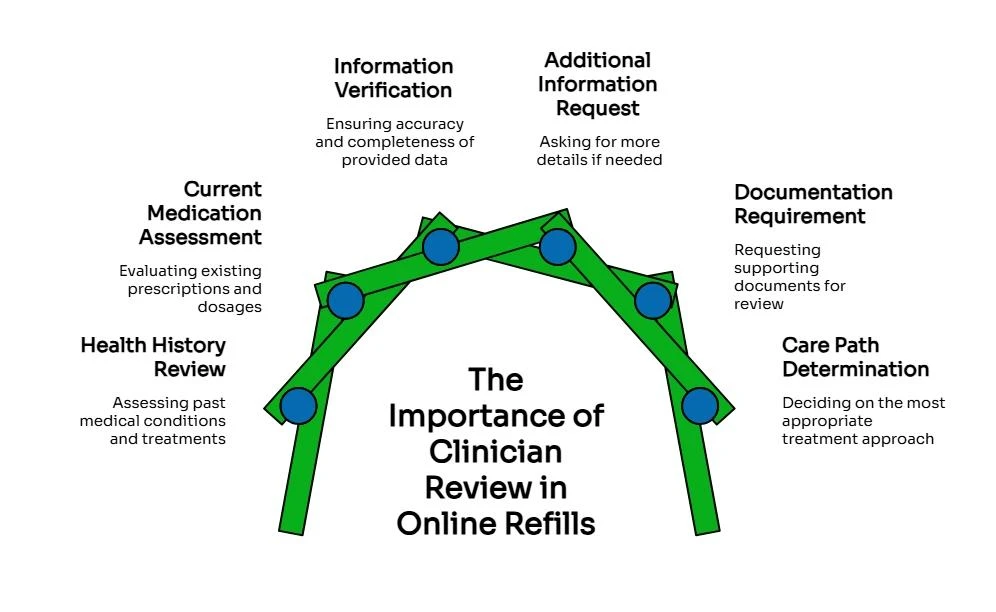
Online refill review does not guarantee approval — and that is by design.
The most persistent assumption about online refill services is that convenience means reduced scrutiny. It does not. A legitimate online refill pathway still involves a licensed clinician reviewing health history, current medication, and the information provided before transmitting any prescription. RefillGenie’s process includes doctor review and direct text communication as deliberate steps, not formalities.
What this means in practice is that a clinician may ask for additional information, request documentation, or determine that a situation calls for a different care path. That is not a failure of the system — it is the system functioning as clinical care should, with a real person making a judgment about what is appropriate.
For patients, understanding this upfront changes how to approach the process. The goal is to provide accurate, complete information and allow a clinician to make an informed decision. Sometimes that decision is a straightforward refill; sometimes it is a follow-up question or a recommendation to be seen in person. Both are valid outcomes.
To understand what distinguishes a responsible online refill service from one that operates without adequate review, the FDA’s BeSafeRx online pharmacy information explains general safety considerations for buying prescription medicine online. The online refill safety checklist also outlines the key indicators worth looking for when evaluating a specific service.
When An Online Refill Request May Fit The Gap-Care Role
While some telehealth platforms offer ongoing chronic disease management, gap-care refill services are designed for a specific and common need: the moment when an existing medication becomes difficult to access through normal channels and waiting for a routine appointment is not a reasonable option.
RefillGenie describes its role explicitly as a temporary bridge — for people on the road, between doctors or insurance plans, or unable to get an appointment in time for an existing medication refill. The service is not a replacement for a primary care relationship. It is a resource for the gaps that real healthcare access creates: a lapsed insurance plan, a recently retired prescriber, a travel schedule that does not align with a prescription expiration date.
An online refill request fits this role best when the medication history is established, the condition and dose have been stable, the medication is not excluded, and the documentation needed for review is available. It is less appropriate when the condition is actively changing, monitoring requirements have not been recently met, or the situation involves clinical complexity a text-based review cannot safely address.
For those navigating care without insurance or during a gap in coverage, cost of prescriptions without insurance covers options for managing pharmacy costs alongside the service fee.
How To Take The Next Step Responsibly
The most useful preparation is honest preparation. Gather medication details, pharmacy information, and an accurate account of any recent symptoms, side effects, or health changes. If there are questions about the medication or the review process, write them down before starting — the text consultation with a clinician is a real opportunity to raise them.
Approach the process with realistic expectations. A clinician may ask follow-up questions, request documentation, or redirect the situation to in-person care. That is not a failure — it is clinical judgment working as it should.
When the situation fits — existing medication, stable history, documentation ready — reviewing whether an online prescription refill request may fit your existing medication situation is a reasonable next step. Whatever path follows, reconnecting with a regular clinician for ongoing care remains important. Online refill services bridge gaps; they do not replace the long-term provider relationship that chronic condition management requires.
Frequently Asked Questions
Does a stable chronic condition mean an online refill is available?
Not automatically. Stability may support a routine review, but medication type, health history, symptoms, refill timing, and clinician judgment all factor into whether a request is appropriate. A clinician reviews each request individually.
What information should be prepared before requesting an online prescription refill?
Prepare the medication name and dose, prescribing history, pharmacy details, remaining supply, refill timing, and an honest account of recent symptoms, side effects, allergies, dose changes, missed doses, or new diagnoses. If the medication requires monitoring, recent lab results should be available if possible.
Can online refill services start a new medication?
RefillGenie states that it does not diagnose acute conditions or start new medications. The service is designed for existing prescriptions, not new treatment decisions.
Are some medications excluded from online refill?
Yes. RefillGenie lists the following as excluded: controlled substances, sedatives, muscle relaxants, GLP-1 injections, erectile dysfunction medications, medications requiring monitoring, hormone replacement therapy, and other medications the reviewing doctor determines are unsafe to refill in this format.
What should be done if symptoms are new, worse, or severe?
A situation with new, worsening, or severe symptoms should not be treated as a routine refill. Contact a licensed healthcare professional to discuss the changes. For severe or potentially life-threatening symptoms, seek urgent or emergency care immediately.
Does the online refill fee include the pharmacy cost?
No. RefillGenie’s service fee covers clinician review and e-prescription transmission for up to three existing medications. A 90-day supply is $59. Pharmacy charges are billed separately and depend on factors such as insurance coverage.
Disclaimer: This article is for general informational purposes only and does not constitute medical advice, diagnosis, or treatment. Prescription refill eligibility depends on individual medication, health history, symptoms, applicable rules, and clinician review. Consult a licensed healthcare professional for guidance specific to your health, medications, symptoms, or treatment options. If you are experiencing severe or potentially life-threatening symptoms, seek urgent or emergency care.
Our Editorial Process:
Our content is developed to help readers understand common refill-gap situations, online refill boundaries, and temporary bridge-care options in plain language. We use Refill Genie source materials, service pages, FAQs, customer-feedback patterns, and relevant external authority sources to guide factual accuracy. Health-related content should be reviewed for clinical accuracy, eligibility language, safety limits, pricing, timing, and commercial terms before publication.
About the Refill Genie Insights Team
The Refill Genie Insights Team is our dedicated engine for synthesizing complex topics into clear, helpful guides. While our content is thoroughly reviewed for clarity and accuracy, it is for informational purposes and should not replace professional advice.