
June 2, 2026
What Makes Maintenance Medication Eligible for an Online Prescription Refill?

📌 Key Takeaways
Online refills work best when they continue a stable prescription, not when they solve a new health problem.
- Stable Prescriptions Review Better: Existing medications with steady doses are usually easier for clinicians to review online.
- Clear Records Matter: A bottle, label, or pharmacy record helps confirm the drug, dose, prescriber, and refill timing.
- Eligibility Is Not Approval: A clinician may approve, ask questions, suggest labs, or direct the patient to in-person care.
- Timing Reduces Pressure: Submitting before the bottle is empty gives the clinician more room to review safely.
- New Problems Need Care: New symptoms, side effects, dose changes, or urgent concerns may need a fuller medical visit.
Prepared information supports safer review, but the clinician still makes the refill decision.
Adults managing ongoing medications during gaps in regular care will gain clear next steps here, preparing them for the detailed overview that follows.
~ ~ ~ ~ ~ ~ ~ ~ ~ ~ ~ ~ ~ ~ ~ ~ ~ ~
When a recurring medication is running low, the first practical question is whether it can be reviewed online or requires a regular doctor visit. For maintenance medications, online refill eligibility is usually less about convenience and more about review readiness — a clinician needs enough information to understand the existing prescription, the current dose, the condition being treated, and any safety factors that could affect whether a refill is appropriate.
An online prescription refill request may be a reasonable starting point when the medication is already part of your care, your dose has been stable, and your information is clear. It is not an automatic prescription. Eligibility depends on clinician review, the medication involved, and the details of your medical history.
Understanding those factors before starting saves time and sets more accurate expectations.
Quick Answer: What Makes a Maintenance Medication More Likely to Be Reviewable Online?
A maintenance medication may be more likely to be reviewable online when it is an existing prescription, the dose has not recently changed, the prescribing history is clear, and there are no obvious safety concerns that require in-person care, lab monitoring, or a new treatment decision. The strongest refill requests give the clinician a clear picture of what is already happening — medication name, dose, prescription label, pharmacy information, refill timing, and recent health updates.
Timing matters too. Requests submitted while some supply remains give a clinician more flexibility than a same-day request with zero doses left.
Eligibility is not approval. A medication can be eligible for review and still not be approved for refill. A licensed clinician may approve the request, ask follow-up questions, recommend additional monitoring, or direct the patient to in-person or urgent care. None of the factors below guarantee a prescription will be issued. They signal that a clinical review can proceed — not that it will end in a refill.
Online Maintenance Refill Readiness Checklist
Before starting an online refill request, gather:
- Medication name and current dose (for example, 25 mg once daily)
- Current prescription bottle, label, or pharmacy record
- Prescribing provider’s name and dispensing pharmacy details
- How long the medication has been taken at the current dose
- Date of last refill and number of doses remaining
- Whether the condition and dose have been stable
- Any recent changes in symptoms, side effects, allergies, or other medications
- Whether the medication requires lab work, monitoring, or may fall into an excluded category
Completing this checklist does not guarantee approval. It means the information is in place for a clinician to begin a proper evaluation.
What “Maintenance Medication” Means in an Online Refill Context
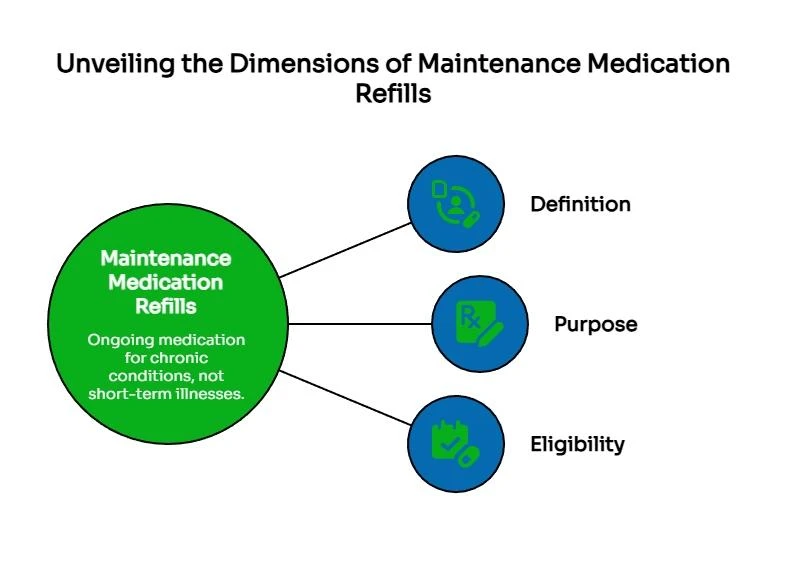
A maintenance medication is one taken on an ongoing basis to manage a chronic or recurring condition, rather than to treat a short-term illness. The CDC broadly defines chronic diseases as conditions that last one year or more and require ongoing medical attention or limit daily activities, or both. Medications for blood pressure, thyroid function, mental health, cholesterol, and similar long-term conditions are typical examples.
This matters in the online refill context because services designed for prescription review are built around this type of medication. They are not set up to evaluate new conditions, diagnose emerging symptoms, or help someone start a treatment they haven’t been on before. RefillGenie, for example, does not diagnose acute conditions or start new medications. It is designed for patients who already hold an existing prescription and need a refill during a temporary gap in access to their regular provider.
In an online refill context, the important point is not the diagnosis itself — it is whether the medication is already established in the patient’s care. A refill request asks a clinician to review whether continuing an existing prescription may be appropriate. It does not ask the clinician to diagnose a new condition or choose a new treatment from scratch. This is why prescription history matters: if the clinician can see what was previously prescribed, how it was taken, and whether anything has changed, the request is easier to evaluate.
The Main Eligibility Factors Clinicians Usually Need to Review
When a clinician evaluates an online refill request, the underlying task is determining whether it is appropriate to issue an e-prescription for this medication, for this patient, at this point in time — without a physical exam. Several factors shape that determination.
| Factor | Why it matters | What to prepare | Possible complication |
|---|---|---|---|
| Medication type | Some medications carry higher review requirements | Medication name, dose, dosage form | Excluded categories may not be reviewable |
| Prescription history | Confirms the medication has been previously prescribed | Prescription label or pharmacy records | Missing history may slow or block review |
| Dose and condition stability | Stable use signals lower clinical risk | Note any recent symptom or side effect changes | Dose-change requests require fuller evaluation |
| Refill timing | Remaining supply gives the clinician flexibility | Date of last refill and doses remaining | Last-minute requests may require in-person care |
| Medical history context | Helps identify changes since the last prescription | Other medications, recent health updates | New conditions or interactions may complicate review |
| Monitoring requirements | Some medications require recent lab results | Recent bloodwork if applicable | Missing labs may need to be addressed first |
Medication type is often the first filter. RefillGenie identifies several excluded categories: controlled substances, sedatives, muscle relaxants, GLP-1 injections, erectile dysfunction medications, high-risk medications requiring continuous specialist monitoring, hormone replacement therapy, and any medication deemed unsafe to refill by the doctor. This should be understood as a safety boundary, not simply a service preference.
Prescription history is equally important. A clinician may need to confirm that the medication was previously prescribed to the patient, that the dose matches the current label, and that the request is for continuation rather than a new treatment decision. This is why a prescription bottle or pharmacy record is more useful than memory alone.
Stability matters in less obvious ways too. A refill request for the same medication at the same dose, with clear records and no recent health changes, is easier to evaluate than a request from someone whose symptoms have recently shifted. The second situation may still deserve care — but it may not fit a routine refill pathway.
What Can Make an Online Refill Request More Complicated
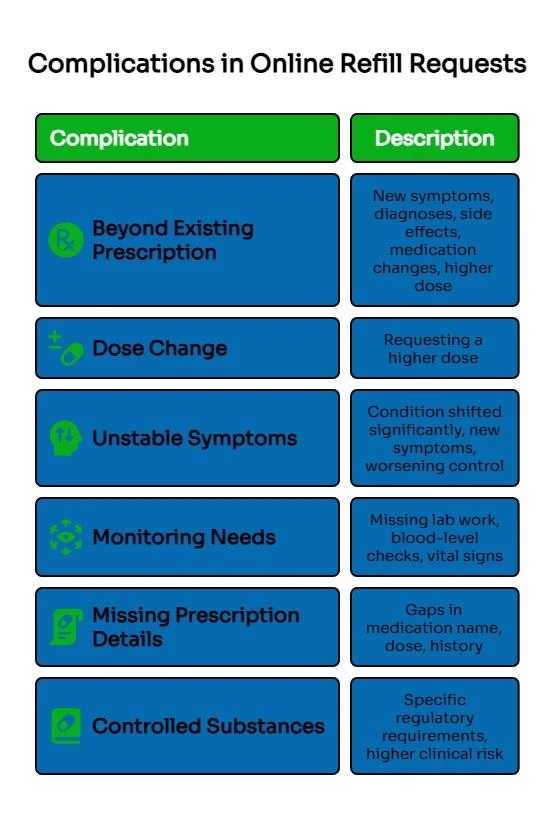
A request becomes more complicated when it moves beyond continuation of an existing prescription. New symptoms, new diagnoses, recent side effects, medication changes, or requests for a higher dose all require a broader clinical evaluation.
A dose change is one of the most common complications. Online refill services focused on existing prescriptions are not built to evaluate treatment adjustments. A person requesting a higher dose is not only asking for a refill — they are asking for a treatment change. That may require a clinician to understand why the dose needs to change, whether the current medication is still appropriate, and whether another type of care is safer.
Unstable symptoms present a similar challenge. If the condition being managed has shifted significantly since the last prescription — new symptoms, worsening control, or an emerging concern — the reviewing clinician may determine that in-person care is the more appropriate next step.
Monitoring needs can also change the clinical picture. Some medications require lab work, blood-level checks, vital-sign review, or ongoing follow-up. If that information is missing, a clinician may need more details before deciding whether an online refill is appropriate. Missing prescription details create a different kind of problem; a clinician cannot safely fill in gaps with assumptions about medication name, dose, or prescribing history.
RefillGenie notes that when bloodwork is required, the lab order and result interpretation are provided at no additional charge. For controlled substances and other excluded medication categories, specific regulatory requirements and higher clinical risk thresholds apply — the prescribing provider or a clinic equipped to manage those medications is the appropriate contact.
What to Prepare Before Starting a Request
The prescription bottle or label is the single most useful document to have available. It confirms the medication name, dose, prescribing provider, dispensing pharmacy, and fill date — all details a reviewing clinician typically needs. If the bottle isn’t available, writing down the medication name, strength, dosing schedule, and last fill date from memory is a reasonable starting point. The pharmacy can usually confirm the details.
Before submitting, also think through any recent changes in health status: new side effects, unusual reactions, or other medications that have been added or stopped. These are the kinds of follow-up questions that tend to arise during review, and having answers ready keeps the process moving.
What to check before you wait is a useful resource for thinking through bottle details and refill timing before a gap becomes urgent. Counting remaining doses while supply is still on hand — rather than waiting until the bottle is empty — gives a clinician more flexibility and gives you more options.
On the question of cost: the online service fee covers clinical review and the e-prescription, not the pharmacy charge. RefillGenie’s 90-day service fee is $59 for up to 3 existing medications. Pharmacy costs are separate and depend on factors including insurance coverage. For those navigating care without insurance, this resource on the cost of prescriptions without insurance can help with planning. GoodRx is also worth checking to compare prices across pharmacies.
Why Eligibility Is Not the Same as Approval
The most common misunderstanding is treating an online refill request like an automatic order. A refill request is still a clinical review. A licensed clinician must decide whether the prescription can be continued based on the information provided.
Medication history, side effects, drug interactions, monitoring needs, and changes in health status can all affect whether a refill is appropriate. The FDA’s Find Information about a Drug resource is a useful official starting point for medication labeling and safety information, but it does not replace clinician judgment.
A legitimate online refill process leaves room for several outcomes: the clinician may send an e-prescription to the pharmacy, ask follow-up questions, recommend lab work, suggest a return to in-person care, or decline the request if online review is not the right fit. Services that approve every request without genuine clinical engagement are not practicing medicine.
Trust signals matter here. Readers evaluating online care should look for clear medication limits, real clinician review, transparent pricing, and sound privacy practices. HHS confirms that telehealth appointments, messages, and related health and billing information are protected by HIPAA when handled by covered providers using appropriate safeguards. For a practical checklist of what to look for in a credentialed, clinician-reviewed service, safe online refill checks outlines the markers worth confirming before submitting a request.
When Online Refill Review May Not Be the Right Path
Online refill review may not be appropriate when the situation involves new or severe symptoms, a new diagnosis, a requested medication change, concerning side effects, or a medication that needs close monitoring. Those situations may require more information than a refill pathway is designed to collect.
Seek urgent or emergency medical care for severe symptoms, chest pain, trouble breathing, suicidal thoughts, signs of a severe allergic reaction, withdrawal concerns, or any symptom that feels urgent or unsafe. An online refill request is not a substitute for immediate clinical evaluation.
Online refill review also does not replace ongoing primary care. RefillGenie describes its service as a bridge for existing medications — a temporary resource to help patients maintain access to chronic medications during gaps in care, not a replacement for a primary care doctor who can perform regular exams and manage health over the long term.
A practical way to decide: is this request mainly about continuing an established prescription, or is it really about evaluating a new concern? If it is the second, a more complete clinical visit is the safer path.
Common Questions About Online Maintenance Medication Refill Eligibility
Can all maintenance medications be refilled online?
No. Some existing maintenance medications may be reviewed online, but eligibility depends on the medication type, documentation, condition stability, monitoring needs, and clinician judgment. Excluded categories — including controlled substances and medications requiring close monitoring — are not eligible.
Do previous prescription details matter?
Yes. Existing prescription details help the clinician understand what was already prescribed, how it was taken, and whether the current request matches the prior medication history. Having the bottle or pharmacy records available helps the review proceed.
Can an online refill service start a new medication?
Not through RefillGenie. The service does not diagnose acute conditions or start new medications. It is designed for refills of existing prescriptions only.
What if the medication requires bloodwork?
Medications associated with close lab monitoring may require a more involved review, and a lab order may be needed before a refill can be issued. RefillGenie provides the lab order and result interpretation at no additional charge when bloodwork is required.
Does the service fee include pharmacy costs?
No. The $59 fee covers clinical review and the e-prescription for a 90-day supply of up to 3 existing medications. Pharmacy charges are separate and depend on factors including insurance.
What should I check before submitting a request?
Confirm the medication name, dose, prescription label, pharmacy, prescriber, last refill date, remaining doses, recent symptoms or side effects, and whether the medication may fall into an excluded or monitoring-required category.
Final Takeaway: Use the Checklist, Then Let Clinical Review Decide
Online refill eligibility for maintenance medications is best understood as a readiness question. A request may be more reviewable when the medication is already prescribed, the dose is stable, the details are clear, and no safety or monitoring issue requires a different kind of care.
The checklist can help organize that information. The clinician still decides whether a refill is appropriate — and that is exactly how it should work.
To take the next step, check whether your medication may be eligible for a refill.
Disclaimer: This article is for general informational purposes only and does not constitute medical advice, diagnosis, or treatment. Readers should consult a licensed healthcare professional for guidance specific to their health, symptoms, medications, or treatment options.
Our Editorial Process:
Our expert team uses AI tools to help organize and structure our initial drafts. Every piece is then extensively rewritten, fact-checked, and enriched with first-hand insights and experiences by expert humans on our Insights Team to ensure accuracy and clarity.
By: The Refill Genie Insights Team
The Refill Genie Insights Team is our dedicated engine for synthesizing complex topics into clear, helpful guides. While our content is thoroughly reviewed for clarity and accuracy, it is for informational purposes and should not replace professional advice.